Why Is Context Switching Becoming a Skill Instead of a Liability?
For twenty years the research said switching focus wrecks your work. The arrival of AI tools that run while you wait quietly flipped that, for people who learn to manage it.
The short answer: Context switching used to be a liability because it interrupted your own deep thinking, and the research on that cost is brutal and real. But a new kind of context switching is emerging, where you direct several AI tools that each take time to process, and you move between them while they work. That isn't multitasking your own mind. It's managing a small team, and it's becoming one of the most valuable skills a small operator can build.
The difference between those two activities is the whole point of this post, and most people are about to confuse them.
This is for the owner or operator who has started using AI tools and noticed something strange: that they spend more time waiting for tools and steering them than typing. That feeling is not a problem to fix. It is the early shape of a skill worth getting good at, and getting good at it early is the advantage.
What's the difference between destructive context switching and the new kind?
The old kind fragments one human brain doing one hard thing. The new kind coordinates several machines each doing a thing while one human supervises. They feel similar from the outside and they are nearly opposite from the inside. One scatters your attention across work only you can do. The other parks finished-enough work with a tool and uses the wait to move the next thing forward.
Here is the cleanest way to see it. In the old model, you are the engine. Every switch stalls the engine and you pay to restart it. In the new model, you are the dispatcher. The engines are the AI tools, and they keep running whether you are looking at them or not. Switching away from an engine that is already running costs almost nothing, because it does not stop when you look away.
That single shift, from being the engine to being the dispatcher, is why a habit that used to drain you can become a skill that multiplies you.
Why does the old research say context switching is so costly?
Because interrupting deep cognitive work forces an expensive mental reload every time, and the bill is larger than almost anyone guesses. Decades of attention research found that the cost is not the interruption itself. It is the long climb back to full focus afterward, repeated all day.
The most cited number comes from Professor Gloria Mark at UC Irvine, whose office studies found it takes an average of 23 minutes and 15 seconds to return to the original task after an interruption, and that workers usually touch two other tasks before they get back. The American Psychological Association, drawing on David Meyer's work, found that the brief mental blocks created by shifting between tasks can cost as much as 40 percent of someone's productive time. The modern workday makes this worse, not better. Knowledge workers now toggle between applications well over a thousand times a day, and Mark's later research found average attention on a single screen has fallen from about two and a half minutes in 2004 to roughly 47 seconds.
None of that is wrong, and none of it goes away. If the work is yours to think through, switching mid-thought is still a tax. The point is not that the research was mistaken. The point is that it measured a specific situation: one person, one mind, work that only that mind could do. Change who holds the work, and the math changes with it.
So why is the new context switching different?
Because the AI tool holds the thread, not you, and a tool does not lose its place when you look away. The expensive part of old context switching was rebuilding the mental state you dropped. When an agent is doing the work, that mental state lives in the agent. Your switch is no longer a stall and a restart. It is a glance away and a glance back.
There is a second thing that makes it different, and it is the part most people miss. AI tools have latency. A research agent takes a minute to read twenty sources. An image tool takes thirty seconds to render. A coding agent takes several minutes to work through a task. A long document takes time to draft. Those waits used to be dead time, the modern version of watching a progress bar. The new skill turns that dead time into the most productive time in the day, because while one tool processes, you move to another that needs you now.
So the work is not happening in parallel inside your head. It is happening in parallel out in the tools, and you are the only place where all the threads meet. You are not thinking four thoughts at once, which no one can do. You are tending four pots at different stages, which any line cook does every night.
What does this actually look like in practice?
It looks like a kitchen during a dinner rush, run by one person who knows where everything is. Several things are cooking, each on its own timer, and the operator moves to whichever one needs attention next, then steps back and lets it work.
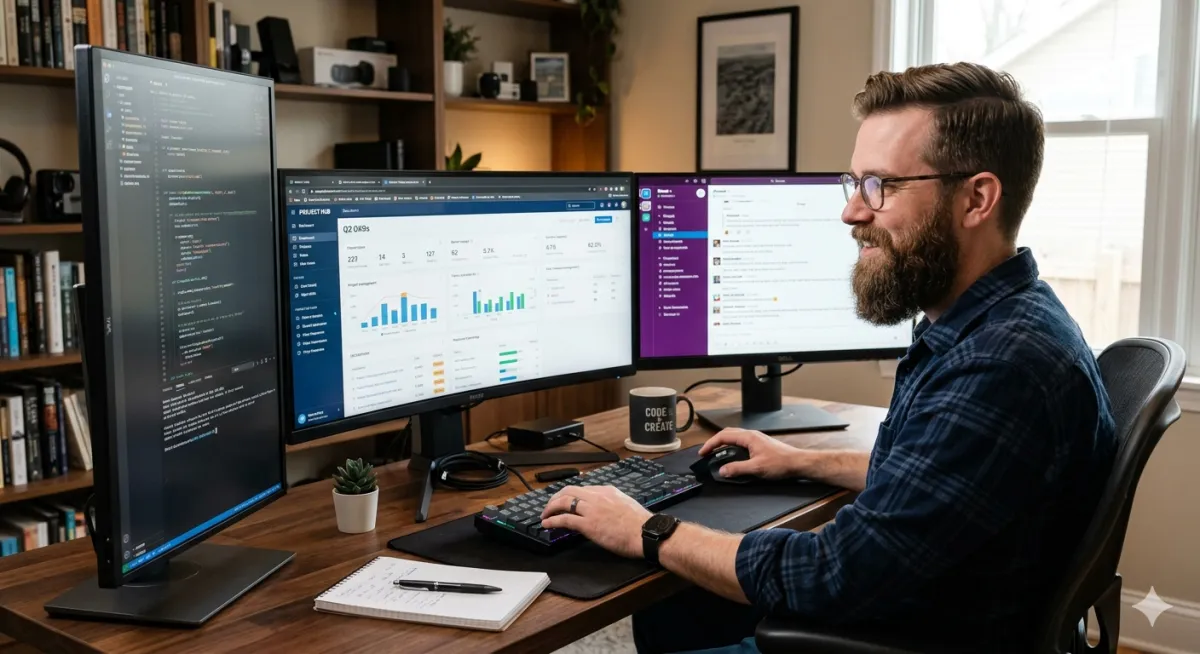
A real session looks like this. Claude Code is working through a build task in one window and will take a few minutes, so that window gets left alone to run. In a second window, a research agent is reading sources for a blog post and will need a minute. While both of those run, the actual writing happens in a third place, by hand, because that part needs a human. A design tool is rendering images for the same post and will ping when it is done. Somewhere in the mix, a separate assistant is drafting the SEO fields and the social copy. None of these are waiting on the others. The operator moves between them as each one finishes, approving, correcting, redirecting, then handing back the next instruction and stepping away again.
This is not science fiction or a big-company setup. The tools to do it are already here and already cheap. Claude Code now runs multiple agents at once and spawns background agents while you keep working, with a view built specifically to let you "hand them off, check status at a glance, and step in only when one needs you." Its newest workflows can coordinate hundreds of parallel subagents in a single session and check their results against each other. The bottleneck is no longer the software. It is whether the person at the center can hold the picture.
Bennin Systems runs this way daily, from a single desk in Paradise Valley, Montana. The reason a one-person operation can produce the output of a small firm is not faster typing. It is that several streams of work are moving at once, and the skill that makes that possible is knowing where each one is and what it needs next.
Why is this becoming a real skill and not just a productivity hack?
Because the shape of knowledge work is moving from doing the task to directing the things that do the task, and that is a different job with different muscles. A hack saves you a few minutes. A skill changes what one person is capable of producing, and this one does that.
The broader market is already naming it. The 2026 conversation in technology is full of "AI orchestration," the practice of coordinating multiple AI agents toward an outcome no single agent could reach alone. Gartner projects that 40 percent of enterprises will have AI agents embedded in their operations by the end of 2026, and the consistent finding across that research is that people are not being removed from the loop. They are moving up a level, from doing the execution to setting direction, making the judgment calls, and approving what matters. That is orchestration, and it is a human role.
For a small business owner, this lands differently than it does for a large enterprise, and better. A big company has to reorganize departments to work this way. A solo operator just has to learn it, and can start this afternoon. The owner who builds this skill now, while most are still typing one task at a time, gets to run like a team of five before anyone has to hire one.
What makes someone actually good at it?
Four things, and none of them is speed. Being good at this is less about moving fast between windows and more about holding a clear model of what is running, what each thing needs, and what only you can do. The fast tab-clicker who has lost the thread is worse off than the calm person running three streams they fully understand.
The first skill is a mental map. At any moment, a good orchestrator can tell you what every open stream is doing and what it is waiting on. Lose that map and the whole thing turns to noise.
The second is triage, knowing which stream needs you now and which can keep running untouched. A tool that is processing does not need you. A tool that just finished and is about to go in a wrong direction needs you immediately.
The third is quality control, and it is the one people underrate. AI tools produce confident, fluent, wrong output on a regular basis. The orchestrator is the only check between that output and the work going out the door. Speed without this is just a faster way to ship mistakes.
The fourth is knowing when not to switch at all. Some work is still yours, alone, with everything else closed. The skill includes the discipline to recognize that work and protect it, because the moment you try to orchestrate a task that needed your full mind, you are back in the destructive kind of context switching the research warned about.
Where does this go wrong?
It goes wrong when motion gets mistaken for progress, and it is an easy mistake to make. Running six tools at once feels productive even when half of them are producing work you will throw away. The honest tradeoffs here are real, and pretending otherwise would be the hype version of this argument.
The first failure is frantic switching with no map, which is just the old destructive context switching wearing a new costume. If you are flipping between windows because you lost track of what each one was doing, you are paying the full 23-minute reload tax over and over, with extra steps.
The second is the supervision tax. Coordinating several streams is genuinely tiring, and there is a ceiling. Most people do well with a handful of active streams and fall apart past that. More tools is not more output once you cross your own limit, and finding that limit honestly matters more than pushing it.
The third is letting quality slip because everything felt fast. The output of four agents you barely reviewed is not four times the work. It can be four times the cleanup. The whole advantage evaporates if the supervision is shallow.
The last one is the quiet one. Some of the best work a person does requires uninterrupted depth, and this skill can crowd it out if you let the dispatcher mindset eat the whole day. Protecting deep work is part of the skill, not a break from it.
How do you start building this skill?
Start with two streams, not six, and grow only when two feels easy. The instinct is to open everything at once and feel the rush. The better path is to run one AI tool on a task with real latency, and during its wait, do one other thing deliberately, then come back. That is the whole motion. Everything else is just more of it, done with a clearer map.
A simple way in is to pair one long-running task with one hands-on task. Let a research or build agent work, and while it does, write or plan the part that needs you. When it finishes, switch, review, redirect, and send it back. After that rhythm feels natural, add a third stream. Pay attention to where your map starts to blur, because that edge is your real capacity, and knowing it is more useful than exceeding it.
There is also the option of not assembling all of this yourself. Bennin Systems builds systems that run several streams of work in parallel for small businesses, real estate professionals, and family operations, so the owner gets the output without having to become the orchestrator on day one. Either path works. The one that does not work is pretending the old one-task-at-a-time pace is still competitive, because for a growing number of people, it already isn't.
The bottom line
Context switching earned its bad reputation honestly, in a world where you were the only engine and every interruption stalled you. That world is ending for a specific and growing slice of work. When the engines are AI tools that run while you wait, switching stops being a stall and becomes dispatching, and dispatching is a skill that lets one person produce like several.
The research on the cost of interruption was never wrong. It was answering a question that is quietly being replaced. The new question is not how to avoid switching. It is how to switch well, and the people who learn that answer early get to operate, for a while, like they have a team that no one can see.
Next steps
Pick one task tomorrow that an AI tool can work on while you do something else, and practice the single motion: hand it off, do the other thing, come back, review, redirect. Notice how little the switch costs when the tool kept your place for you. That small, repeatable loop is the entire skill in miniature, and it scales further than it looks.
From there, two honest paths. You can build the habit yourself, one added stream at a time, until running several at once feels like running a kitchen instead of juggling. Or, if you would rather have the parallel systems built and handed to you, Bennin Systems does that for small operators across Montana and beyond. Either way the goal is the same, and it is the one this whole brand is built on: working on your business, not lost inside it.
Frequently asked questions
Isn't all the research clear that context switching hurts productivity?
It is, for the situation it studied: one person doing cognitive work only they can do. Interrupting that still costs roughly 23 minutes of refocus each time. The new kind is different because AI tools hold the work while you step away, so the expensive mental reload mostly disappears. The old findings still apply to your own deep work.
Isn't this just multitasking with extra steps?
No. Multitasking means doing two things with your own attention at the same time, which the brain cannot actually do and pays dearly to fake. This is sequential supervision of several tools that run on their own. You attend to one stream at a time. The parallelism happens in the tools, not in your head, which is exactly why it works.
How many tools or agents can one person realistically manage?
For most people, a handful of active streams, not dozens. The limit is how many you can hold a clear mental map of at once. Past that, you lose track, quality drops, and you slide back into the destructive kind of switching. Finding your honest ceiling matters more than pushing it.
Do I need to be technical to build this skill?
No. The skill is direction, triage, and judgment, not coding. The current tools are built for non-technical users, and the hard part is keeping a clear picture of what is running and catching errors before they ship. That is a management skill, not an engineering one, and most operators already have the raw version of it.
What's the biggest mistake people make when they start?
Opening too many streams too fast and confusing motion with progress. Six tools running feels productive even when half are producing work you will discard. Start with two, grow only when two feels easy, and review everything. Speed without supervision is just a faster way to ship mistakes.
Where do AI agents go wrong that I have to watch for?
They produce confident, fluent, incorrect output on a regular basis. An agent will finish a task and be quietly wrong, or drift in the wrong direction if left alone too long. The human supervisor is the only check between that and the work going out. Quality control is the part of this skill people most underrate.
Does this mean I should automate or parallelize everything?
No. Some work still requires your full, undivided mind, and the skill includes recognizing that work and protecting it. Trying to orchestrate a task that needed deep focus puts you right back into the costly switching the research warns about. The goal is parallel where it helps and single-focus where it matters.
Is this realistic for a small business, or just for tech companies?
It is arguably better suited to small businesses. A solo operator can adopt it this week without reorganizing anything, while a large company has to restructure teams to work this way. The tools are already cheap and available, so the limiting factor is the skill, and that is exactly the kind of edge a small operator can build before larger competitors do.
Bennin Systems, Paradise Valley, Montana. (406) 224-3267. benninsystems.com
Stacy Bennin is the founder of Bennin Systems, an operational systems and AI automation consultancy based in Paradise Valley, Montana. She builds custom websites, automated client acquisition systems, brand identity, and operations workflows for small businesses, real estate professionals, and family operations. She is also a licensed Montana real estate broker affiliated with Legacy Lands Real Estate. Reach her at benninsystems.com.
