What Does It Actually Cost a Small Business to Not Automate Anything?
The bill never arrives, because it is paid in the two things an owner can't make more of: time and attention.
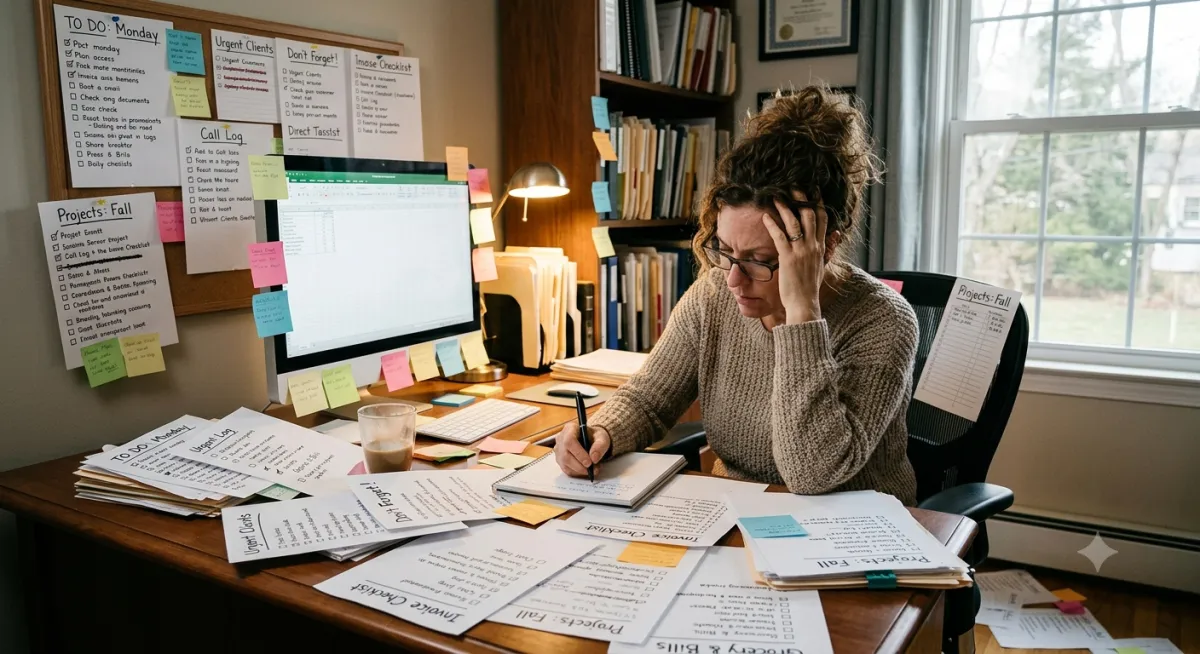
The short answer: Not automating anything costs a small business its owner's time and attention, the only two resources you cannot buy more of. The price never shows up as an invoice, which is exactly why it goes unpaid attention for years. It shows up instead as a 55-hour week, a business that cannot grow past you, and a life quietly absorbed into the work. Research finds small business owners spend roughly two-thirds of their time working in the business and only about a third working on it. That ratio is the cost.
There is no line item for it. No vendor sends a bill for the hours you spent doing by hand what a system could have done while you slept. That is what makes it the most expensive cost most owners never measure.
This post is for the owner who suspects they are the bottleneck in their own business, and wants to see the real price of staying that way before deciding what to do about it.
Why doesn't the cost of not automating ever show up on a bill?
Because it is paid in time, not money, and time has no invoice. When you buy a tool, the cost is obvious: a charge on a card every month. When you skip the tool and do the work yourself, the cost is just as real, but it hides inside your week. You feel busy, not billed. The money you "saved" was paid in hours you will never get back.
This is why so many owners conclude that doing it manually is the cheaper option. On the bank statement, it is. On the clock, it is often the single most expensive choice in the business. An hour you spend copying data or chasing an invoice is an hour subtracted from selling, building, or simply living, and that hour does not come back.
The first step to seeing the cost is to stop measuring it in dollars and start measuring it in the resource it actually consumes.
Where does the time actually go?
Into the small, repetitive tasks that fill a week without growing the business. The work that eats an owner's day is rarely the work that built the business. It is the follow-up, the invoicing, the scheduling, the data entry, the re-typing of the same information into three different places.
The numbers are consistent and sobering. Administrative tasks alone consume around a third of a small business owner's workweek, roughly 16 hours, and a 2025 SCORE survey found owners and their teams spend 15 to 25 hours a week on tasks that could be automated, broken down into customer follow-up, invoicing and payment collection, appointment management, and lead follow-up. Broader analysis from McKinsey in late 2025 estimated that already-demonstrated technology could automate activities accounting for over half of all work hours.
Here is where a typical week leaks.
| Task that quietly eats the week | Hours it can consume | What it actually is |
|---|---|---|
| Customer and lead follow-up | 5 to 8 per week | A sequence a system runs on its own |
| Invoicing and chasing payment | 3 to 5 per week | A recurring job that should be automatic |
| Scheduling and appointment juggling | 2 to 4 per week | A booking link and a reminder flow |
| Re-entering the same data | several per week | A one-time connection between tools |
None of these is the work only you can do. All of them are taking the time you need to do it.
What's the real price of an owner's hour?
Everything you could have done with it instead. Time and attention are the only two things an owner genuinely cannot make more of. You can raise money, hire help, and buy tools, but you cannot add an hour to the day or a second stream of focus to your one mind. So every hour spent on automatable work is not free. It is bought with the highest-value thing you own.
Think about what your hour is worth at its best: closing a client, designing the next offer, having the conversation that becomes a referral for a decade. Now picture spending that hour formatting a spreadsheet. The spreadsheet got done. The client did not get called. That is the trade, made quietly, dozens of times a week, and it never appears on a report.
Attention is the scarcer half. Even when a task only takes ten minutes, the interruption fractures the focus that the real work depends on. The cost of not automating is not just the minutes. It is the deep work those minutes keep chopping into pieces.
How does doing everything by hand cap your growth?
By making you the ceiling. When the business runs on the owner's hands, the business can only ever be as big as the owner's capacity, and that capacity is already full. There is no room to grow, because there is no spare hour to grow into. You are not running the business so much as holding it up.
This is the trap underneath the long hours: more customers means more manual work, which means more of your time, until you hit the wall of a full week and simply cannot take on more without something breaking. Many owners try to buy their way out by hiring, which can help, but often just means paying a person to do by hand what a system would do for a fraction of the cost, without the manual work ever going away.
A business built on systems grows differently. The next ten customers do not cost you ten customers' worth of hours, because the system absorbs the repeatable part. That is the difference between a business that scales and a job that owns you.
What does not automating cost beyond money and growth?
Your life outside the work. This is the cost that matters most and gets measured least. Owners who do everything manually work around 50 hours a week, with a third working more than that, and many cannot disconnect even after hours, losing personal evenings to problems the business could have handled on its own.
The point of building a system was never efficiency for its own sake. The point is the hour it gives back: the dinner you are present for, the weekend that is actually a weekend, the margin to raise a family or rest or think. A business is supposed to support a life. When it consumes the life instead, the cost of not automating has been paid in the one currency that does not refund.
That is the honest weight of this question. Not automating does not just cost money or growth. Left long enough, it costs the reason you started.
Automating isn't about doing more, it's about doing less of the wrong things
The reframe that matters is this: automation is not a way to cram more into the week. It is a way to take the wrong work out of it. The goal is not a busier owner with more tools. It is an owner whose hours go to the handful of things only they can do, while the repeatable rest runs quietly in the background.
The honest tradeoff is that automation is not free. Building a system costs money up front and a little time to set up, and a tool nobody uses is just another expense. So the real comparison is never "free manual work versus paid automation." It is the one-time cost of building the system against the ongoing, compounding cost of paying for it in your hours forever. Seen that way, the math usually is not close. Owners who automate customer communication and operations commonly recover tens of thousands of dollars a year in labor and revenue value, and the time saved is the part that does not fit on a spreadsheet.
There is also a limit worth naming. The goal is not to automate everything, and some of the most valuable work should stay firmly in human hands. Automate the rote. Protect the parts that are the actual relationship.
The bottom line
The cost of not automating anything is real, large, and nearly invisible, because it is paid in time and attention instead of dollars. It shows up as two-thirds of your week spent working in the business instead of on it, a growth ceiling set by your own capacity, and a life slowly absorbed into the work. No invoice ever names it, which is precisely why it goes unpaid attention for years.
You do not fix this by working harder. You fix it by moving the repeatable work off your hands and onto a system, so your time goes back to the work, and the life, that only you can have.
Next steps
Track your hours for one week and mark every task that did not require your judgment, the data entry, the follow-up, the scheduling, the re-typing. Add up that time. That number, multiplied across a year, is roughly what doing nothing is costing you, and it is usually larger than anyone expects.
From there, two paths. You can start by automating the single task that eats the most of your week, often customer follow-up, and reclaim those hours first. Or, if you would rather have the systems built and running so the repeatable work simply stops landing on you, Bennin Systems does that for small businesses, real estate professionals, and family operations across Montana and beyond. Either way the goal is the same: get your hours back, and spend them working on your business and on your life, not buried in it.
Frequently asked questions
What does it really cost to not automate my business?
It costs your time and attention, paid weekly and never invoiced. Concretely, that looks like 15 to 25 hours a week on tasks that could run themselves, a business that cannot grow past your personal capacity, and long hours that eat into your life. The dollar figure is hidden, but it commonly runs to tens of thousands a year in lost time and revenue.
Isn't doing things manually cheaper than paying for automation?
On your bank statement, yes. On your clock, usually no. Manual work feels free because no vendor bills you for it, but it is paid in your hours, which are your most valuable and least renewable resource. The honest comparison is the one-time cost of a system against paying for the task in your time, every week, forever.
Which tasks should a small business automate first?
Start with whatever eats the most of your week and requires the least judgment. For most businesses that is customer and lead follow-up, then invoicing and payment reminders, then scheduling. These are repetitive, high-volume, and rule-based, which makes them both the easiest to automate and the most expensive to keep doing by hand.
Will automating make my business feel impersonal?
Only if you automate the wrong things. The goal is to automate the rote work, the reminders, the data entry, the routing, so you have more time for the human moments that are the actual relationship. Done well, automation makes a business feel more personal, because the owner is no longer too buried in admin to show up for customers.
How much time can automation actually give back?
Often a day a week or more. Teams that automated invoicing and follow-up have freed up hundreds of hours a year, and SCORE found owners spend 15 to 25 weekly hours on automatable tasks. You will not reclaim all of it, but recovering even half is the difference between a 55-hour week and a sane one.
Isn't this only worth it for bigger businesses?
It is often most valuable for the smallest ones, because in a one or two-person business the owner is the bottleneck for everything. A large company has staff to absorb manual work. A solo operator does not, so moving repeatable work onto a system is the only way to grow without simply working more hours.
Does automation replace hiring?
Sometimes it delays or reduces the need, and sometimes it makes your existing team far more effective. The point is not to avoid people, it is to avoid paying people, or yourself, to do work a system does better and cheaper. Automate the repeatable tasks first, then hire for the judgment and relationship work that should stay human.
What's the risk of automating the wrong thing?
Mostly wasted money and a process that feels cold, which is why sequence and judgment matter. The fix is to automate the clearly repetitive, low-judgment tasks first and leave the high-touch work alone until you are sure. A system built without that judgment can create new problems, which is the difference between automation that helps and automation that just adds noise.
Bennin Systems, Paradise Valley, Montana. (406) 224-3267. benninsystems.com
Stacy Bennin is the founder of Bennin Systems, an operational systems and AI automation consultancy based in Paradise Valley, Montana. She builds custom websites, automated client acquisition systems, brand identity, and operations workflows for small businesses, real estate professionals, and family operations. She is also a licensed Montana real estate broker affiliated with Legacy Lands Real Estate. Reach her at benninsystems.com.
