
What is missed Call Text Back and How does it Work
What is missed Call Text Back and How does it Work
Every small business loses money on missed calls. Not in some abstract way. In a way you can put a dollar figure on, if you sit down and do the math.
Someone calls your business at 2:47 on a Tuesday afternoon. Nobody picks up. They were ready to book, ready to buy, ready to ask the question that turns into a job. Then they hang up, look at the next result on Google, and call the company below yours. You will never know they called. You will never know what they wanted. You will never know what that call was worth.
Missed call text-back is a small piece of automation that fixes a piece of that problem. It is not a miracle. It is one of the cheapest, most boring, most consistently useful things a small business can put in place. Most clients who turn it on tell us within the first month that they cannot believe they ran their business without it.
Here is what it actually is, how the mechanism works, what it costs, when it pays for itself, and when it is the wrong choice.
The mechanism in plain language
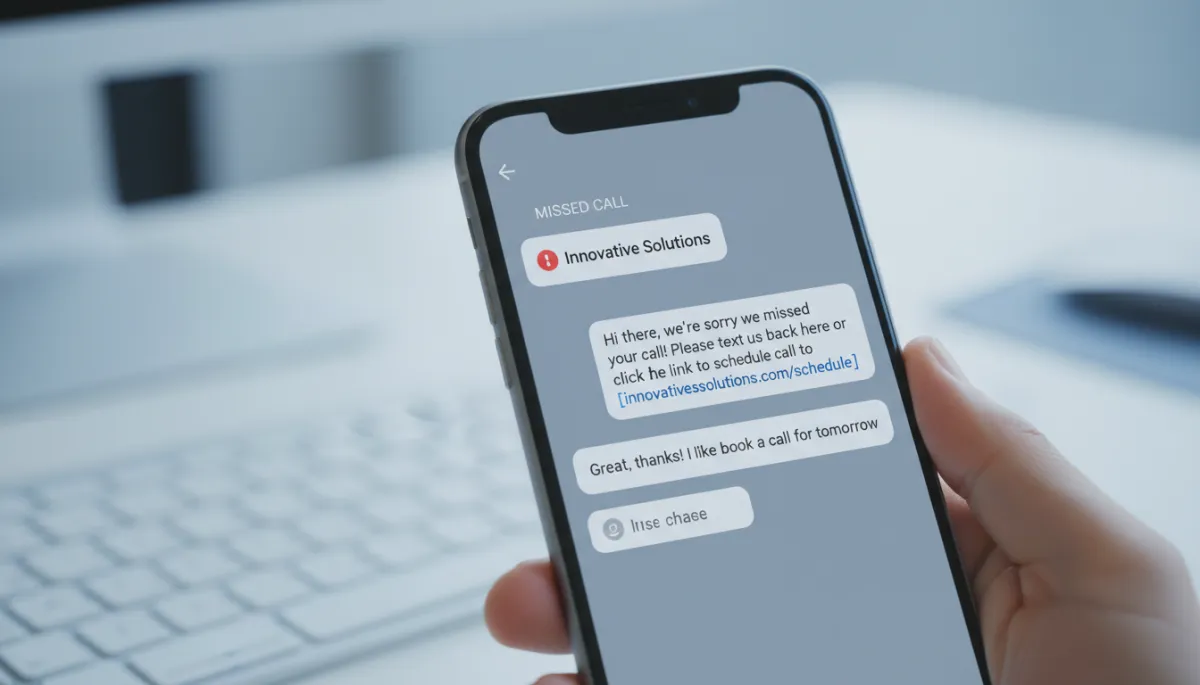
Missed call text-back is exactly what the name says. When someone calls your business and the call is not answered, the system sends that caller a text message within a few seconds.
The text comes from the same number they just called. It says something like "Hey, this is Sarah at Maple Street Dental. We just missed your call. What can we help you with?" The caller can reply by text, and now you have a conversation in writing instead of a missed call you never knew about.
That is the entire system. There is no AI deciding whether to send the message. No complicated logic. No setup that takes a week. The trigger is "missed call." The action is "send a text." That is it.
Why it works
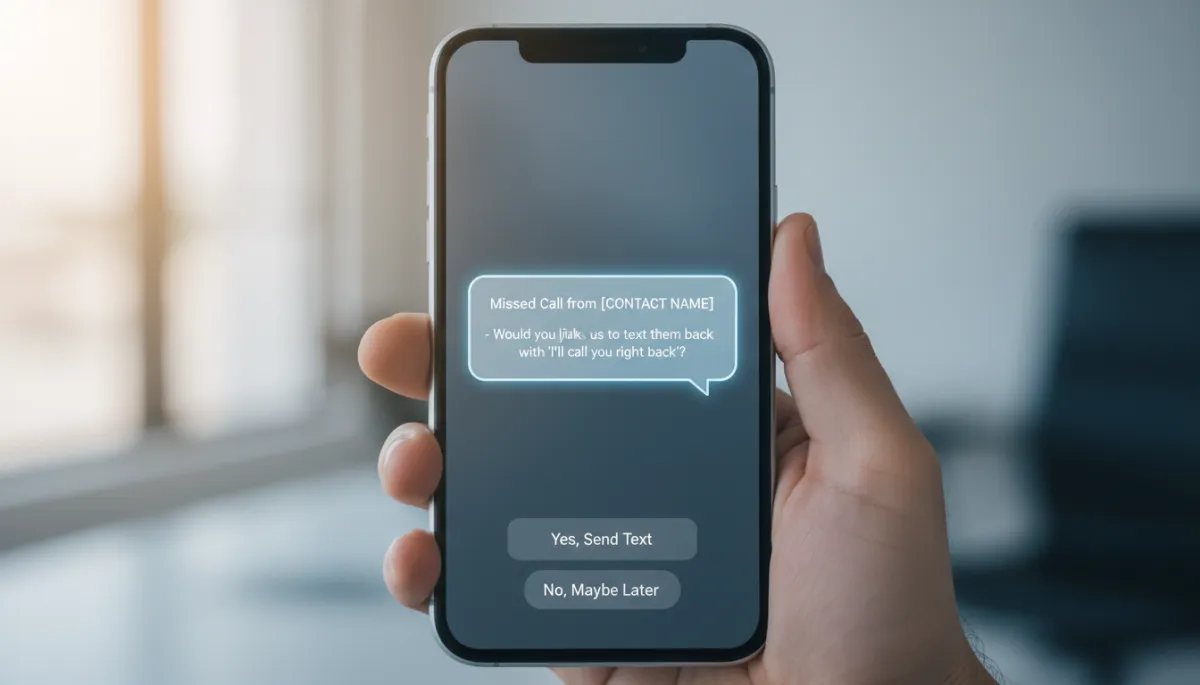
There are three reasons missed call text-back consistently outperforms its complexity.
The first is timing. People call when they are ready to act. By the time they hang up unanswered, they are still in the moment. A text that arrives within ten seconds catches them while their attention is still on you. A return call thirty minutes later reaches a different person, in a different mental state, who has often already moved on or already booked someone else.
The second is the channel switch. Many people who would not pick up a return call from a number they do not recognize will absolutely respond to a text from a business they just called. Texting feels lower-stakes. It does not interrupt them. They can answer in the middle of a meeting, while standing in line, while putting their kid in the car. A return phone call asks for more from them than a text does.
The third is the paper trail. A texted conversation is searchable, forwardable, and reviewable. The person who first responds to the lead can hand it off to the team member who actually services the account, with the entire conversation visible. Phone calls do not do this without effort.
What you need to make it work
The mechanics are not complicated, but the setup involves a few pieces.
You need a business phone number that can both make and receive calls and send and receive SMS. Most small businesses already have something like this, whether through a VoIP provider, a CRM with a built-in phone number, or a simple business line they use for everything.
You need a system that can detect a missed call on that number and trigger an outbound text within a defined time window. This is the actual automation layer. It can live inside an all-in-one platform like GoHighLevel, a standalone tool like CallRail or OpenPhone, an automation built on Twilio's API, or a workflow stitched together in Zapier or Make. The platform matters less than people make it sound. What matters is that the trigger is fast and the message is sent reliably.
You need a place for the inbound texts to land. This is the piece most people forget. If the response goes to an inbox nobody checks, the whole system is a waste. Most teams route the responses to either a shared inbox the front desk monitors, a CRM the salesperson uses, or directly to the business owner's phone for very small operations.
You need a written message that sounds like your business. Generic auto-replies feel cold. A message that uses your business name, the staff member's name, and a real question gets responses at three to four times the rate of "Sorry we missed your call. Please leave a message." This is the part most platforms get wrong out of the box, and it is the easiest part to fix.
Whether you build this in GoHighLevel, build it directly on Twilio, or use a standalone tool depends on what else you need the system to do. If you already have a CRM you trust and you only need this one feature, a focused tool is fine. If you are also running automated follow-up, lead routing, calendar booking, and review requests, you probably want the whole system in one place. There is no universal right answer.
Real numbers from real businesses
A dental office with two phone lines was missing roughly forty calls a week. Most were rebookings, insurance questions, and new patient inquiries. After turning on missed call text-back, they recovered about twenty-eight of those forty conversations within a few hours, and converted about nineteen into either a rebooked appointment, a new patient consultation, or a clarified insurance question. They did not hire anyone. They did not change their hours. The text-back system caught the calls the front desk could not get to during procedures.
A residential cleaning company was losing about twelve quote requests a week to voicemail. They knew this because they tracked it. After implementing text-back, the response rate on missed calls went from "almost zero" to about seventy-five percent within the first hour. Their close rate on those text conversations was lower than their close rate on live phone calls, but they were closing deals that previously would have been zero.
A petroleum supply company servicing commercial accounts uses the same mechanic for a different reason. Their drivers are in the field and cannot answer the office line during deliveries. When a driver misses a call from a customer, the text goes back automatically with "We just missed you. Reply with your account number and what you need, and we will be in touch within the hour." Most of those replies route directly to the dispatcher, who can handle the request without the driver ever stepping out of the truck.
These are unremarkable businesses with unremarkable results. That is the point. The systems that quietly recover money are usually small and unglamorous.
When missed call text-back is the right move
There are a few clear signals.
You miss calls regularly. If your team picks up almost every call already, this automation does very little for you. If your staff is small, your call volume fluctuates, or you operate in a field where you cannot always be near a phone, the value is real.
Your callers are mobile-first. If your customer base is older, less comfortable with text, or operating in B2B contexts where formal email is the norm, the response rate drops. Most consumer service businesses, real estate inquiries, home service trades, and local professional offices see strong response rates. Some industrial B2B accounts see weaker results.
Your average customer is worth more than the cost of the system. Most missed call text-back tools cost somewhere between fifteen and seventy-five dollars a month, depending on the platform and the volume. If your average customer is worth two hundred dollars and you recover even one of them a month, you are well ahead.
You have someone who can respond to the texts. This sounds obvious. It catches more businesses than you would expect. The system creates conversations. Those conversations need to land somewhere with a human who can handle them within a reasonable window. Same day is fine. Three days later is not.
When it is the wrong choice
There are also a few signals that this is not the right tool for your situation.
You are a sole operator with no time to handle texts during the workday. Adding another inbox to your day does not help if you cannot get to it. In that case, what you actually need is either a virtual assistant or a real answering service with a person on the line. Automation cannot substitute for capacity you do not have.
Your callers are calling about emergencies. A plumbing company handling burst pipes, a mobile mechanic dealing with stranded drivers, a medical office handling urgent issues. Text-back is not appropriate for emergency volume. People in crisis need a person, not a workflow. A live answering service is the right tool here.
Your business takes very few calls. If you get four calls a week and you answer three of them, the math does not work. The setup time will outpace the savings.
Your industry has compliance requirements that complicate automated texting. Healthcare, legal services, financial services, and a few others have specific rules about what an automated text can say and what consent is required. The rules can be navigated, but they need to be respected. Skipping past them creates risk that outweighs the recovered calls.
The deeper point
Missed call text-back is a useful piece of automation, and it is also a useful illustration of how the right small system thinks about a problem.
The mechanism does not try to do everything. It does not attempt to qualify the lead, schedule the appointment, send the quote, and follow up six times in the next month. Other systems can do those things. This one solves a single, narrow problem: the gap between when a call is missed and when a human can engage. That gap is where revenue leaks, and the system plugs it. Nothing more.
Most of the operational systems that actually move the needle for a small business look like this. Small. Boring. Targeted at one specific gap. They run quietly in the background and pay for themselves in the first month. They do not require a transformation, a course, or a six-figure consultant.
What missed call text-back does for incoming calls, similar small systems can do for new leads, fulfillment handoffs, review collection, and a dozen other places where small businesses lose time and money to gaps in coverage. The pattern is the same. Find a specific gap. Build a specific tool. Make sure the responses land somewhere a human can handle them. Move on to the next gap.
The technology is not the interesting part. The interesting part is choosing which gaps to close first, in what order, and at what cost. That is the work. Tools come and go. Systems thinking is the durable asset.
If your business is missing calls and the cost of those calls is real, this is one of the easier wins available. Most platforms can have it running in under an hour. The script that goes out matters more than the platform you choose. The inbox where the replies land matters more than either of those. Get those three pieces right and the math takes care of itself.
Frequently Asked Questions
1. How fast does the text actually go out after a missed call?
On most platforms, within five to ten seconds. The trigger fires the moment the call ends without being answered, so the caller usually sees the text before they have put the phone back in their pocket. If your platform is sending texts on a delay of more than thirty seconds, something is configured wrong or the platform itself is not built for this. Speed is most of what makes this system work.
2. Will my callers think the response is automated?
Some will, some will not, and it mostly does not matter. What matters is whether the message sounds like it came from your business. A text that says "Hey, this is Sarah at Maple Street Dental, we just missed your call, what can we help with?" reads as a real person even if the caller half-suspects automation. A text that says "We are sorry we missed your call. Please leave a message at the tone." reads as a robot. The script you write does the heavy lifting. People are forgiving of automation that respects their time.
3. Does this work with a landline or only with a cell phone?
Most landlines cannot send or receive SMS directly, so the answer depends on how your phone system is set up. If you are using a VoIP provider, a CRM with a built-in number, or a service like Google Voice, the number can usually handle both calls and texts. If you have a traditional copper landline, you will either need to port the number to a service that supports texting or set up a parallel SMS-enabled number that mirrors your business line. The porting process is usually painless and takes a few business days.
4. What happens if someone replies and we still cannot get to them quickly?
The system is only as good as the human on the other end of the inbox. A common pattern is to have the auto-text set an expectation the business can actually meet, something like "We will get back to you within the hour during business hours." Then the inbox needs to be monitored often enough to honor that promise. If your team genuinely cannot respond within an hour during the day, set the expectation longer, or route texts to a virtual assistant or answering service. Promising fast replies and not delivering them is worse than no auto-text at all.
5. Is this legal, and do I need consent to send the text?
For a response to a call the customer just placed to your business, the legal footing is generally solid in the US under TCPA, because the customer initiated contact. Sending a single text in direct response to their call is treated very differently from cold outbound texting. That said, the rules tighten quickly if you start sending follow-up messages, marketing texts, or messages days later. Healthcare, legal services, and financial services have additional layers to consider. The simplest rule is this: respond once to the missed call, keep the response factual and helpful, and do not bolt on automated marketing follow-ups without explicit consent. If your industry has compliance requirements, get a one-time review from someone who knows the rules for your space before turning anything on.
