How Does Your Google Business Profile Affect Whether You Get Found?
The storefront before the storefront, and most owners have never stopped to look at their own.
The short answer: Your Google Business Profile is usually the first thing a stranger sees about your business, and it is one of the first things a machine reads when deciding whether to recommend you. Google says businesses with complete and accurate information are more likely to show up in local search results. A thin, stale, or inconsistent profile quietly gets passed over, and you never find out.
Bennin Systems builds the systems that make small businesses findable, and for a local business, findable starts here.
Here is the number worth sitting with before anything else. According to BrightLocal's Local Consumer Review Survey 2026, a survey of 1,002 US consumers, 97% of people read reviews for local businesses, and the share of consumers using AI tools to find local business recommendations jumped from 6% in 2025 to 45% in 2026. The way strangers evaluate you changed faster in one year than it had in the previous ten. Your Business Profile sits in the middle of both numbers.
What Is a Google Business Profile, Really?
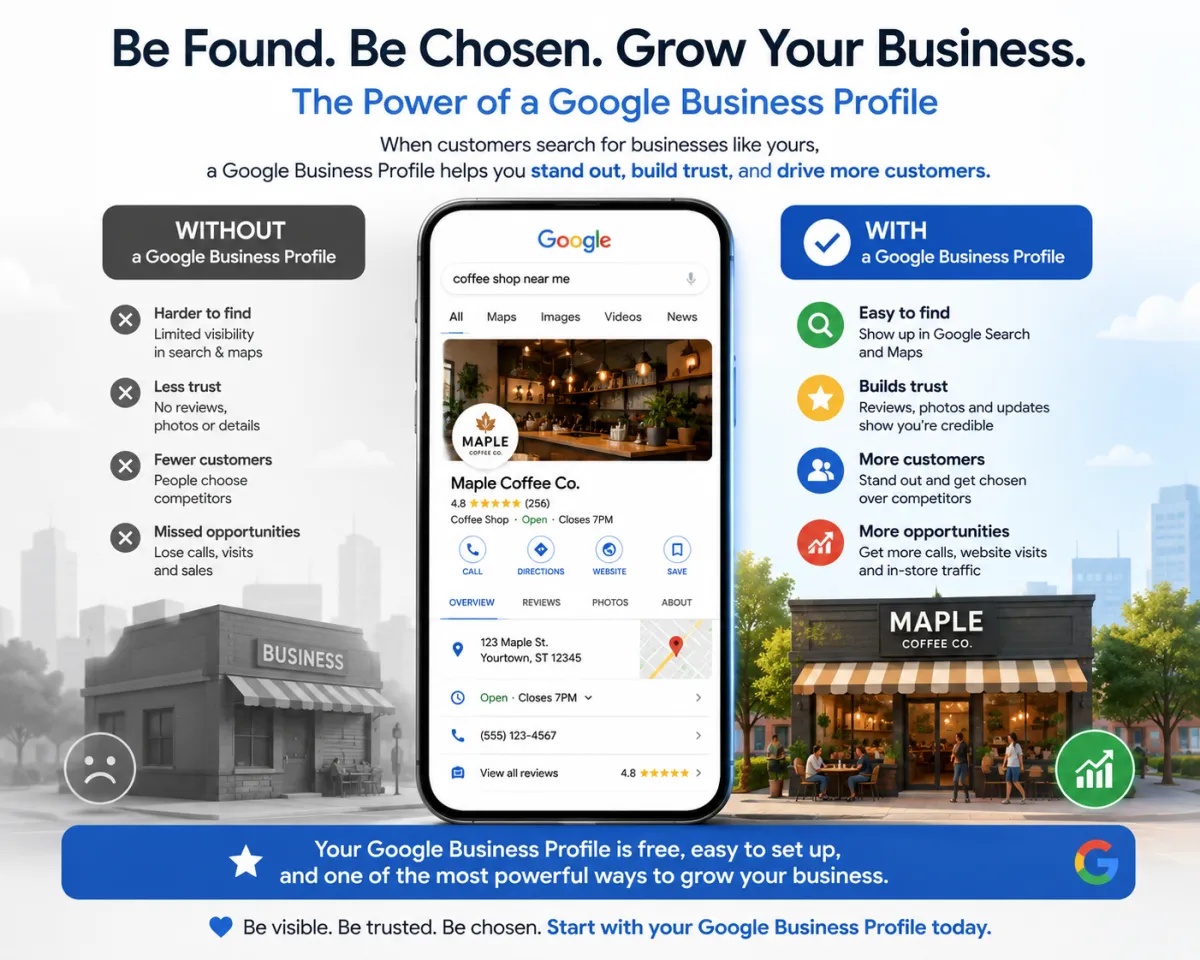
A Google Business Profile is the free listing that represents your business on Google Search and Google Maps: your name, address, hours, phone number, photos, services, and reviews, all in one card. It is not your website. It is the thing people see before they ever decide to visit your website.
Think of it as the storefront before the storefront. When someone in Livingston searches "oil change near me" or asks their phone for a good bookkeeper, the map results they see are Business Profiles, not websites. The profile decides whether you make that first cut. The website only matters if you do.
Most owners treat the profile as a formality. Claim it once, confirm the phone number, move on. That made sense in 2015. It does not make sense now, because the profile stopped being a phone-book entry and became a data source that both Google and AI tools read when someone asks who to call.
How Does Google Decide Which Businesses to Show?
Google is unusually plain about this. Its own documentation, Tips to improve your local ranking on Google, names three factors: relevance, distance, and prominence. Relevance is how well your profile matches what someone searched. Distance is how far you are from them. Prominence is how well-known your business appears to be.
Two of those three are things you influence directly.
The relevance line deserves a second read. Google states directly that businesses with complete and accurate information are more likely to show up in local search results, and that verifying your profile tells Google you are authorized to represent the business. There is no secret trick behind that sentence. Notice what the same page does not say: nothing about posting every day, nothing about gaming keywords into your business name. The machine is asking a simpler question. Does it understand what you do well enough to match you to the person asking?
An empty profile gives it nothing to match. That is the whole failure, and it is common precisely because it is invisible. Nobody calls to tell you that you did not come up.
Why Does the Profile Matter More Than a Polished Website?
Because the profile is where the evaluation happens. By the time someone reaches your website, they have usually already judged you on the map card: the star rating, the review count, the photos, whether the hours look current. The same BrightLocal survey found that 74% of consumers want to see reviews written in the last three months, and 31% will now only use a business rated 4.5 stars or higher, up from 17% just a year earlier.
Read those two numbers together and the picture is uncomfortable but useful. A strong reputation from 2023 does not carry. Recency is part of trust now. A profile with eight reviews, the newest from last fall, reads as a business that might not be fully alive, even if your actual calendar is booked out six weeks.
This is not an argument against having a good website. A website that captures and follows up still does the converting, and a website that looks fine but never brings you business is its own solvable problem. The point is sequence. The profile gets you considered. The website gets you chosen. Owners tend to invest in the second and neglect the first, which means they lose people they never knew were looking.
What Does Your Profile Have to Do With AI Recommendations?
More than most owners realize, and less directly than most marketers claim. When 45% of consumers ask AI tools for local recommendations, those tools assemble answers from what they can read: business websites, directories, social profiles, news mentions, and the broader public record of your business. Google's own AI results are the exception, since they draw on the profile itself. For the third-party tools, BrightLocal's CEO puts it bluntly: ChatGPT and other AI search tools cannot see inside Google's walled garden of reviews, so they lean on everything else that describes you.
That is why, in practice, consistency has become a visibility asset in its own right. If your business name, address, phone number, and description say the same thing on your profile, your website, and everywhere else you are listed, a machine can be confident about who you are. If your profile says one name and your website says another, confidence drops, and machines are less likely to recommend businesses they cannot describe with confidence. The pattern behind why customers find local businesses differently now runs straight through this point: you are no longer just being found by people. You are being vouched for, or not, by systems that read.
The encouraging part of the same BrightLocal research: among the survey's AI users, 88% double-check what the machine tells them, either verifying a review is legitimate (51%) or checking the source (37%). The AI answer starts the shortlist. Your profile and reviews still close it. Which means the same one asset is now working two jobs, the new version of showing up on Google and the old one, at the same time.
What Happens When a Profile Gets Suspended?
In the worst cases it disappears from Search and Maps entirely. In others, the listing sits frozen while you lose the ability to manage it. Either way, for a local business that leans on the profile, the damage starts before anyone figures out why. Bennin Systems has been through a suspension and reinstatement firsthand, and the experience changed how much respect this one asset gets around here.
Suspensions happen because Google believes a profile violates its guidelines for representing your business: the rules requiring your real-world business name, a precise and accurate address, no P.O. boxes standing in for locations, no keywords stuffed into the name field. Plenty of suspensions hit honest businesses that made an innocent change, like editing an address or updating a category, that tripped an automated filter.
Getting reinstated is a process, not a phone call. Google's own instructions for fixing a suspended profile route you through an appeals tool where you submit evidence such as business licenses, tax certificates, or utility bills, and the evidence form expires 60 minutes after you open it. Google is also explicit that you should not create a new profile for the same business while an appeal is under review, which is exactly what a panicked owner is tempted to do, and it makes things worse.
The lesson from the inside: the appeal went through because the underlying records were clean and consistent, name matching, address matching, documentation ready. The businesses that struggle with reinstatement are usually the ones whose information was loose to begin with. The boring discipline of accurate, consistent records is not just how you rank. It is how you get your digital storefront back when Google takes it away.
What Should You Actually Do About It?
Start by looking at your own profile the way a stranger would. Search your business name, then search what you do without your name in it. Look at what comes up: the photos, the rating, the newest review's date, whether the hours are right, whether the description sounds like your business or like nobody wrote it.
Then ask the harder question, which is not "is my profile okay" but "is my information consistent everywhere a machine might read it." That is a systems question, not a marketing task, and it is the difference between a profile that quietly works and one that quietly leaks.
Your Business Profile is the one piece of your online presence that Google, your customers, and every AI tool are all reading at once. It deserves the same care as your front door.
The practical next step: pull up your profile today and check three things, the newest review's date, the accuracy of your hours, and whether your business description actually says what you do and where. If any of the three fails, you have found real work worth doing before you spend another dollar on ads. And if you want help making your business legible to the people and the machines deciding who to recommend, Bennin Systems builds that system so it stays accurate without you policing it, because being invisible online has a cost whether or not you ever see the invoice.
Frequently Asked Questions
What is a Google Business Profile?
A Google Business Profile is the free listing that represents your business on Google Search and Google Maps. It holds your name, address, hours, phone, photos, services, and reviews. For most local businesses it is the first thing a potential customer sees, before your website and before your front door.
How much does a Google Business Profile cost?
Nothing. Google offers Business Profiles at no charge, and no payment improves your ranking. What the profile costs is attention: keeping information complete, accurate, and current. Google's own guidance says complete and accurate information makes a business more likely to appear in local search results.
Why did my business stop showing up on Google Maps?
The most common causes are an incomplete or unverified profile, information that conflicts with other listings, or a suspension for a guidelines violation. A suspension can remove the profile from Search and Maps with little warning. Google provides an appeals process where you submit documentation proving the business is legitimate.
Do AI tools like ChatGPT read my Google Business Profile?
Mostly not directly. Google's own AI results draw on the profile, but third-party tools like ChatGPT build recommendations from what they can read publicly: your website, directories, social profiles, and mentions. Consistency between your profile, website, and other listings is what lets any machine describe your business with confidence.
How many Google reviews does a local business need?
There is no magic number, but recency and rating both matter more than volume. BrightLocal's 2026 survey found 74% of consumers want reviews from the last three months, and 31% will only use a business rated 4.5 stars or higher. A steady trickle of recent reviews beats a large stale pile.
Can I fix a suspended Google Business Profile myself?
Yes. Google's appeals tool walks you through confirming your account, selecting the profile, and submitting evidence such as licenses or utility bills. The evidence form expires 60 minutes after opening, so gather documents first. Do not create a new profile for the same business while the appeal is pending.
Is my website still important if the profile does the finding?
Yes. The profile and the website do different jobs. The profile gets you seen and considered by people and machines. The website receives that attention and turns it into a call, a booking, or a sale. A strong profile pointing to a website that captures nothing wastes the attention it earned.
Bennin Systems, Paradise Valley, Montana. (406) 224-3267. benninsystems.com
Bennin Systems builds the automated systems small businesses need but rarely have time to set up themselves: lead capture and follow-up that runs on its own, chatbots that answer questions and take orders around the clock, custom websites that act as an employee, and the back-office workflows that keep an operation from running on memory and sticky notes. Located in Montana, Bennin Systems works with businesses and real estate professionals anywhere in the United States.
