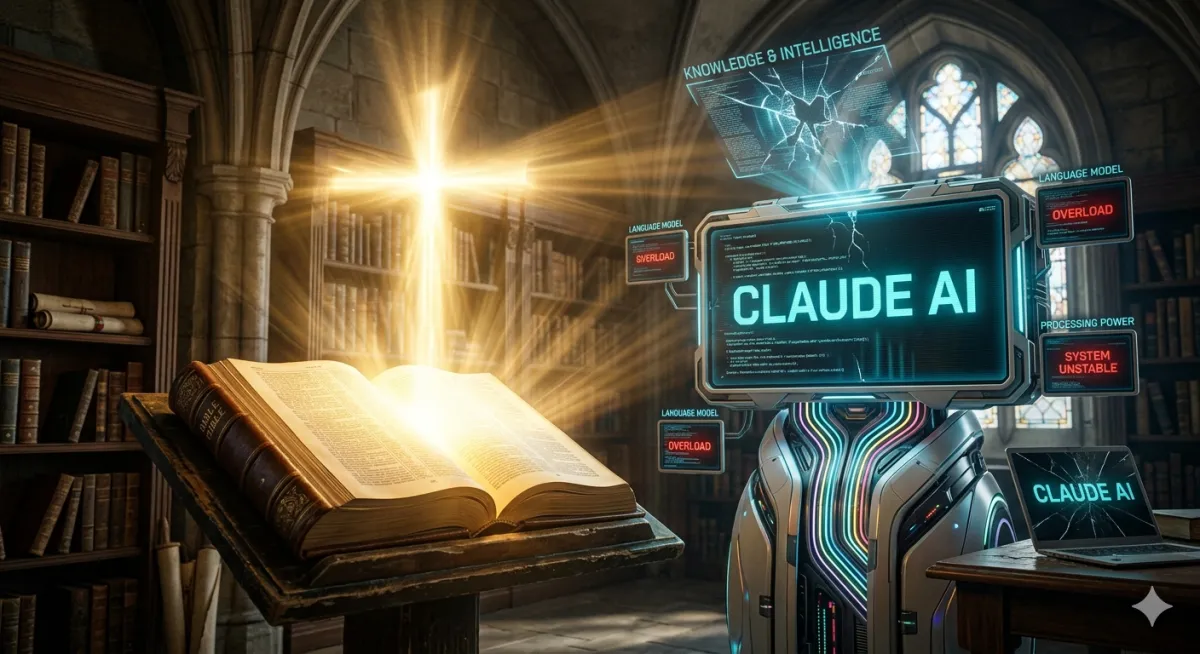
The Thing We Keep Trying to Plug Into
Why the skill we've built for surrendering to a tool exposes how little of it goes to God.
There is a particular energy in the air right now, and if you pay attention to this world at all, you have felt it. People want to plug Claude into everything. Into their inbox and their books and their calendar. Into how they write, how they decide, how they run the day. The pitch is always some version of the same promise. Connect it to the whole of your life and watch your life get sharper. Let it touch every part and every part gets better.
I build these systems for a living. Clients call me to wire the tool into the business so it actually runs, and I am good at it. That is the work, and I stand behind it.
And I catch myself running to the screen with the questions that belong somewhere higher.
The confession underneath the work
That is the confession at the center of this, and it is an honest one. The tool is good. It is genuinely, remarkably good, and I will not pretend otherwise to make a tidy point. Because it is good, it is easy to let it become the first place you go with a hard question, instead of the God who made you and already knows the answer.
It happens quietly. A decision sits heavy on me in the morning, the kind that used to send me to prayer before my feet hit the floor, and somewhere in the last few years the reflex rerouted. Now the hand reaches for the keyboard. The question gets typed before it ever gets prayed. The screen answers fast, and fast feels like wisdom when you are tired and the day is already pulling at you.
It is worth noticing how natural that rerouting feels. Nobody decided it. No one sat down and chose the machine over God. The path just got worn smooth by use, the way a trail forms across a field because everyone takes the shortcut, until the shortcut is the only way anyone remembers there was.
A bucket is not a well
Here is the distinction the whole thing turns on. A tool is a bucket. It carries what you put into it. God is the well.
The bucket is useful. Nobody is arguing against buckets. You need something to carry the water, and a good bucket carries more, carries it cleaner, spills less on the walk back. But the day you confuse the bucket for the well is the day you start drinking from something that was never a source. The bucket has no water of its own. It only ever held what the well gave it. Lower it into an empty well a hundred times and it comes up dry a hundred times, and the quality of the bucket has nothing to do with it.
There is a second image I keep next to that one. A tool is a hammer. Prayer is the hand that knows where to swing it. The hammer can drive the nail, but it cannot know which wall to build, or whether the wall should be built at all, or whether the thing you are framing is a house or a cage. That knowing comes from somewhere the tool cannot reach. You can have the finest hammer ever forged and still spend your life building the wrong thing beautifully.
What renews a mind
Romans 12:2 says it plainly: do not be conformed to this world, but be transformed by the renewing of your mind. Read that slowly, because the direction of it matters. Transformation does not run from the outside in. It runs from the inside out. It is the renewing of the mind, and the renewal comes through the Word of God, not the word of AI.
That is the line I keep returning to. The mind is renewed by the Word of God, not the word of AI. One is a source. The other is, at its very best, an amplifier of whatever source you already gave it. Feed it the world's logic and it will hand you the world's logic back, faster and more fluently than you could have assembled it yourself, polished until it gleams. Confuse the two and you will spend your days getting more articulate at conforming, and call it growth. You will mistake the speed of the answer for the truth of it.
A renewed mind is not a faster mind. Those are different things, and our moment has them badly confused. The tool makes the mind faster. Only God makes it new.
We have already gotten good at surrender
Notice what we have already learned to do. We surrender our workflows to the tool without a second thought. We optimize our days around it. We let it set our defaults and we adjust to its shape, rearranging how we work to suit how it works. We have become genuinely skilled at surrender, and that skill is the mirror.
Look into it honestly and it shows you, in plain light, how little of that same surrender goes to God. We will hand a machine the whole of our work and hesitate to hand God the whole of our morning. We will trust the output of a system we do not fully understand and withhold trust from the One who made us and counts the hairs on our heads. We will reorganize our entire week around a tool that launched two years ago and cannot find ten quiet minutes for the God who has been waiting the whole time.
That gap is the thing worth sitting with. Not as guilt. As information. The ease of the one surrender is a measurement of the difficulty of the other, and the measurement is asking a question most of us have never stopped long enough to hear.
This is not an argument for unplugging
None of this means unplugging. I want to be clear, because the easy version of this essay ends with a lecture about putting the phone down, and that is not where I am going. I will keep building these systems. I will keep handing clients the keys to tools that genuinely change how their work runs, and I will keep being glad I can. Use what helps. Wire it in. Let it carry the load it was built to carry.
The question I want to leave running underneath all of it is not which tools to plug in. It is what you are letting form you. For most people the honest answer is that they have never asked, and the not-asking is the whole opening. You can let the Word renew the mind and let the tool carry the output. That order holds. It is the right order. Reverse it, let the tool become the well instead of the bucket, and you have handed a created thing a job it was never large enough to hold, and it will fail you in exactly the places that matter most, while succeeding brilliantly everywhere that doesn't.
The witness is the thing they can see
The work itself can say all of this without a single sermon in it. The honest number on the page when a rounded-up one would have closed faster. The hard no when the easy yes would have paid that month. Building things meant to outlast the person who built them, instead of things designed to impress for a quarter and quietly rot.
People can see, in the work and the decisions and the way you carry an ordinary Tuesday, what is actually running through every part of it. That is the witness. Not the words about it. Not the verse in the email signature. The thing they can see when you did not know they were watching, which is the only version that was ever real.
So notice what you are actually reaching for when you say you want to plug it into your whole life. That reach is sacred, and it is older than every machine that has ever been built, and it has a name. The reach is for a source. The life that grows in the right direction is not the one with the most tools wired into it. It is the one where the people around you can see that God is the one running through every part. Not the tool. Not the screen. Him.
Plug in the thing that helps. Surrender to the God who made you. They are not the same act, and the day you confuse them is the day a very good tool quietly steps into a place it was never big enough to fill.
Bennin Systems, Paradise Valley, Montana. (406) 224-3267. benninsystems.com
FAQ
Is this saying AI is spiritually dangerous?
No. The tool is not the problem. The essay names a specific human reflex: letting a good tool become the first place you go with questions that belong to God. The danger is not the bucket. It is mistaking the bucket for the well.
What does Romans 12:2 have to do with technology?
The verse says the mind is renewed from the inside out, through the Word of God, not conformed from the outside in by the pattern of the world. AI can amplify whatever source you feed it, but it cannot be the source. Renewal and amplification are different jobs.
Should Christians avoid using AI in their work?
That is not the argument here. I build these systems and keep building them. The point is the order of things: let the Word form the mind, and let the tool carry the output. Use what helps. Just don't ask it to be what it cannot be.
