What Is AEO, and Why Does It Matter More Than SEO Now?
SEO got you onto the page of options. AEO gets you into the sentence that answers the question.
The short answer: AEO, Answer Engine Optimization, is the work of making your business the answer AI engines give when customers ask a question, instead of one link among ten. It matters more now because people increasingly receive a single answer rather than a results page. SEO is not dead. It is the foundation AEO stands on.
Bennin Systems builds content and visibility systems for small businesses in Montana and beyond, and this post practices what it explains. Here is what AEO actually is, in plain English, and how it changes the work without throwing out what you already know.
What Is Answer Engine Optimization in Plain English?
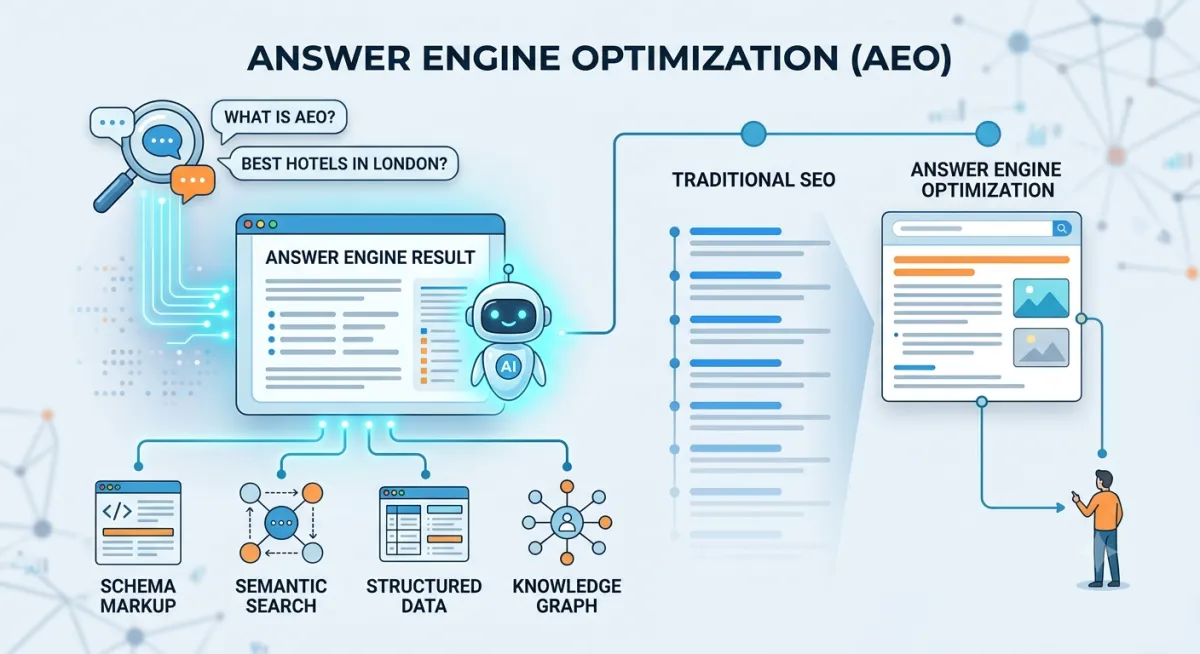
Answer Engine Optimization is the practice of structuring your online presence so that AI engines can read it, verify it, and quote it when someone asks a question your business answers. The engines in question are the ones now fielding those questions: ChatGPT, Perplexity, Microsoft Copilot, and Google's own AI Overviews.
The old game was ranking: get your page as high as possible on a list of blue links and win the click. The new game is selection: when the engine composes its one answer, it chooses a small number of sources to draw from and cite. AEO is the work of becoming one of them.
That's the whole concept. No mystery, no secret handshake. The engine wants to give a person a correct, useful answer. Your job is to be so clearly, consistently, and verifiably useful that quoting you is the engine's easiest path to a good answer.
The results page was a shelf, and SEO was the fight for eye-level placement. An AI answer is a recommendation from something people are learning to trust. Getting recommended is a different job than getting shelved, and most businesses are still only doing the first one.
What Changed to Make the Answer Matter More Than the Ranking?
The behavior changed, measurably and fast. People stopped clicking through lists and started accepting answers, which means the value that used to spread across ten ranked links now concentrates into the handful of sources an engine actually cites.
The numbers tell the story plainly. SparkToro's analysis of Similarweb clickstream data found 68% of US Google searches ended without a single click from January through April 2026, up from just over 60% in 2024. Fewer than a third of searches now send anyone to any website. The answer on the page, increasingly assembled by AI, is the whole transaction.
Meanwhile the asking moved. Pew Research Center's February 2026 survey of 5,119 US adults found 49% now use AI chatbots, up from 33% in 2024, with searching for information their most common use. And in BrightLocal's Local Consumer Review Survey 2026, 45% of the 1,002 US consumers surveyed said they had used AI tools for local business recommendations, up from 6% a year earlier.
This is the same shift traced in why the way customers find local businesses is changing: the question a customer asks never changed. What changed is who answers it, and showing up in that answer is the new version of showing up on Google.
None of this deserves panic, and the numbers are not a countdown clock. They are a map of where attention went, so you can meet it there.
Does SEO Still Matter, or Has AEO Replaced It?
SEO still matters, and anyone telling you otherwise is selling something. AEO is not a replacement for search optimization. It is the newly decisive layer on top of it, and the foundation underneath it is the same one you were already supposed to have built.
Google says this itself. Its own guidance on AI features in Search states there are no additional requirements to appear in AI Overviews, no special files, and no secret markup: the standard search essentials still govern. A page has to be indexed, eligible, and genuinely helpful before any AI feature will touch it. The fundamentals did not get replaced. They got a harder final exam.
Because here is what did change: the standard those fundamentals are graded against. A page could rank in the old world by being adequately optimized without being particularly clear. An answer engine composing a response has no use for adequate. It needs a source that states facts plainly, answers the actual question, and holds up when cross-checked. The sloppy middle of the internet, optimized enough to rank but too vague to quote, is the layer AI answers skip.
So the honest framing is a stack, not a funeral. SEO earns you eligibility. AEO earns you selection. The work overlaps heavily, which is good news: nothing you did well is wasted, the same way blogging didn't die but changed jobs. What ends is the era of doing that work halfway and getting by.
One warning while we're being honest. A wave of vendors is currently selling AEO as a proprietary trick, a special file, a secret schema only they know. Google's documentation flatly says no such thing exists for its AI features. If someone's pitch depends on a secret, walk. What actually moves the needle is unglamorous: clarity, consistency, structure, and proof.
How Is Optimizing for an Answer Different From Optimizing for a Ranking?
The difference is the unit of success. SEO plays for position on a list a human will scan. AEO plays for inclusion in an answer a machine will compose. That one change ripples through what you write, how you structure it, and how you measure whether it worked.
Here is the comparison side by side:
| Classic SEO | AEO | |
|---|---|---|
| What you win | A position on a results page | A place inside the one answer given |
| Unit of success | Clicks to your website | Being cited, quoted, or recommended |
| How people ask | Short keywords ("plumber Bozeman") | Whole questions ("who should I call about a well pump in Paradise Valley?") |
| Content that wins | Keyword-matched pages | Direct, quotable answers to real questions |
| Who judges you | Mostly one algorithm | Several engines with different tastes |
| What builds trust | Links and domain authority | Verifiable, consistent facts across your whole presence |
Two rows deserve emphasis. First, the questions. People type fragments into a search box but speak full sentences to a chatbot, so content that mirrors real questions, and answers them in the first breath, matches how answers get assembled. Second, the judges. There is no longer one gatekeeper to reverse-engineer. The practical response is not to chase four algorithms but to be so plainly readable that every engine reaches the same conclusion about you.
What the table can't show is the overlap: both columns reward expertise, honesty, and structure. The divergence is in tolerance. A results page had room for you on line seven. An answer has no line seven.
What Does AEO Look Like in Practice for a Small Business?
In practice, AEO is four habits applied consistently: write content shaped like the questions customers ask, answer each question directly before elaborating, keep your business facts identical everywhere they appear, and label your information with structured data so machines read it instead of guessing. None of it requires becoming a technologist. All of it requires care.
The post you are reading is a working example. Every section opens with a question someone actually asks and answers it immediately. The facts carry sources. A machine reading this page does not have to guess what it is about, and that is the point: the format is the strategy.
The same practice runs across our client work. Every post Bennin Systems publishes, for this site and for client sites, ships with structured data attached, the article labeled as an article and every question and answer labeled as exactly that, using the shared vocabulary at Schema.org that Google's structured data documentation is built on. On a Montana real estate client's site this month, we confirmed those labels render in the live page exactly as Google's testing tools expect to find them. The client writes nothing and labels nothing. Her content simply goes out readable.
The last habit is consistency, and it is the least glamorous and most load-bearing: the engine cross-checks you before it vouches for you, which is the subject of why AI doesn't recommend businesses it can't verify. Facts that match everywhere are the cheapest credibility available.
The honest tradeoffs: measurement is murkier than SEO ever was, because a citation in someone's chatbot answer never shows up in your analytics. Results build over months, and engines change their behavior without notice. What you control is the readable, verifiable version of your business, built once and maintained. That asset compounds regardless of which engine wins.
The Bottom Line
AEO is not a new trick to buy. It is the old discipline of being findable, held to a new standard: instead of ranking among ten options, you are auditioning to be the answer itself. SEO remains the foundation, and Google itself says no secret markup gets you into AI answers. What gets you in is what always should have: clear answers to real questions, facts that check out everywhere, and structure a machine can read.
The businesses that treat that as plumbing to install this year, rather than a trend to watch, are the ones the answers will already trust by the time their competitors start asking what AEO stands for.
Next Steps
Open your most important page and read the first hundred words as a stranger. Does it directly answer a question a customer would actually ask, or does it talk about you? That gap is your AEO to-do list, in miniature.
If you want the whole system handled, Bennin Systems builds it for you: content shaped around real questions, facts reconciled everywhere you appear, structured data attached and verified, so every engine that gets asked about you finds something worth quoting.
Frequently Asked Questions
What does AEO stand for?
AEO stands for Answer Engine Optimization: the practice of structuring your content and business information so AI engines like ChatGPT, Perplexity, Copilot, and Google's AI Overviews can read, verify, and cite it when composing answers. The goal is being included in the answer, not just ranked on a results page.
Is AEO the same thing as GEO?
Nearly. GEO, Generative Engine Optimization, is another name for optimizing content so generative AI systems cite it, and the two terms largely overlap in practice. Some practitioners use AEO for question-answering features and GEO for AI-written responses broadly. The habits underneath both labels are the same: direct answers, verifiable facts, clear structure.
Do I need to stop doing SEO to do AEO?
No. SEO and AEO are a stack, not a choice. Standard search fundamentals, indexing, helpful content, and technical health still determine whether engines can find and trust your pages at all. AEO adds a higher standard on top: content clear and direct enough to be quoted in an answer, not just listed.
Does Google require special markup to appear in AI Overviews?
No. Google's own documentation says there are no additional requirements, no special files, and no secret schema for its AI features. Pages need to be indexed, snippet-eligible, and genuinely helpful. Structured data still helps machines understand your content, but treat anyone selling a proprietary AI Overview trick with skepticism.
How do ChatGPT and Perplexity decide which businesses to mention?
They compose answers from sources they can read and verify, favoring content that answers the question directly, states specific facts, and stays consistent across the web. A business whose services, location, and details are plainly written and match everywhere gives an engine an easy, safe citation. Vague or contradictory information gets passed over.
Can I measure AEO the way I measure SEO traffic?
Not cleanly, and honesty matters here. Citations inside AI answers usually never appear in your analytics, so part of the payoff is invisible. What you can do: periodically ask the major engines the questions your customers ask and see whether you appear, and watch for customers who arrive already informed about you.
How long does AEO take to show results?
Months, not weeks, and anyone promising a date is guessing. Engines revisit and re-evaluate sources on their own schedules, and confidence in your business builds from consistency over time. The practical takeaway is sequence: the sooner your presence is readable and verifiable, the sooner that clock starts running in your favor.
Is AEO worth it for a small local business?
Yes, arguably more than for anyone else. Engines answering local questions favor specific, consistent, verifiable local detail, which a small business can produce more credibly than a national brand. Few local competitors have made this a priority yet, so the early mover claims citation ground that is slow to give back. The window favors whoever moves first.
Bennin Systems, Paradise Valley, Montana. (406) 224-3267. benninsystems.com
Stacy Bennin is the founder of Bennin Systems, where she builds the automated systems small businesses need but rarely have time to set up themselves: lead capture and follow-up that runs on its own, chatbots that answer questions and take orders around the clock, custom websites that act as an employee, and the back-office workflows that keep an operation from running on memory and sticky notes. Located in Montana, she works with businesses and real estate professionals anywhere in the United States. She is also a licensed Montana real estate broker affiliated with Legacy Lands Real Estate. Reach her at benninsystems.com.
