Why Do Most Small Business Automations Break Within Six Months?
They rarely break because the technology failed. They break because of how, and by whom, they were built.
The short answer: Most small business automations break within six months because they were bolted on, not built in. Someone, often an outside contractor or an agency, wired together a chain of tools, handed over a system nobody inside the business understands, and moved on. When a tool updates, an edge case appears, or one link in the chain changes, the whole thing quietly stops, and there is no one left who knows how to fix it. The failure is not technical. It is a failure of ownership.
Industry analyses estimate that 30 to 50% of automation projects fail outright, and nearly half produce no lasting value, even in companies with real budgets and staff. For a small business, the odds are not kinder. The pattern is.
This post is for the owner who paid for automation that worked beautifully for a while and then quietly fell apart, and who wants to understand why, so the next one lasts.
Why do automations break in the first place?
Because they are built on top of a business instead of into it. An automation is a chain: a trigger in one tool, an action in another, a handoff to a third. Every link is a place where something can change, and over time, something always does. A tool updates its interface, an account password rotates, a form field gets renamed, a new kind of customer does something the builder never anticipated. Each of those is small. Any one of them can snap the chain.
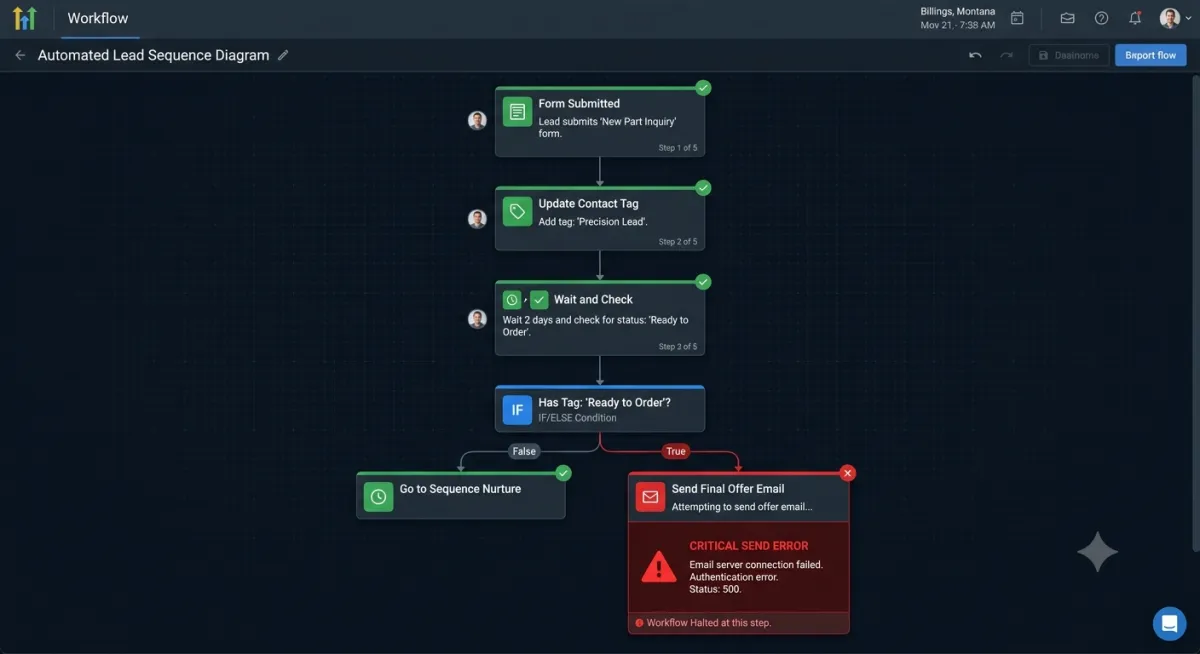
The reason this is fatal rather than annoying is that most small business automations have nobody watching them. They were set up to run unattended, which is the point, and then left genuinely unattended, which is the problem. The break happens silently. The leads stop flowing into the system, the follow-ups stop sending, and you find out weeks later when a customer asks why no one called.
So automations do not usually break with a bang. They drift, and the drift goes unnoticed because the whole appeal was not having to watch.
What does "bolted on by someone who left" actually mean?
It means the knowledge of how the system works walked out the door with the person who built it. This is the most common and most expensive version of the problem. An agency or freelancer comes in, assembles something clever out of several tools, and hands you a working result with none of the understanding behind it. It runs. You are happy. They leave.
Then it breaks, and you discover what you actually bought: a black box. You do not know which tools are connected, why they were connected that way, or where to even start looking. The person who knew is gone, unreachable, or expensive to bring back. You are now dependent on someone who is no longer there to keep your business running, which is a strange and vulnerable place to be.
A system you cannot understand is a system you do not really own. You are renting the builder's knowledge, and the day they leave, the rent comes due all at once.
Why does it break specifically around six months?
Because six months is about how long it takes for the world the automation was built in to change. On day one, everything matches: the tools are the versions the builder used, the process is the one they mapped, the cases are the ones they planned for. That alignment is the honeymoon, and it does not last, because nothing about a working business holds still.
Within a couple of quarters, a tool has pushed an update, your process has shifted a little, a new kind of request has appeared, or a subscription you forgot about has lapsed. The automation was a snapshot of how things were the day it was built, and the business has quietly moved on without it. Six months is roughly when enough small drift accumulates that the first real crack appears.
The automations that survive past this point are not the ones built more cleverly. They are the ones built to be maintained, by someone who is still around to do it.
Why are long automation chains so fragile?
Because every added step multiplies the ways the whole thing can fail. A no-code automation that strings together five or six tools looks impressive and behaves like a row of dominoes: when one link in the chain stops working, it can take the whole sequence down, and finding which link broke can mean hours or days of untangling. The more complex the chain, the more brittle it is, not less.
This is why so many automation efforts stall out. Analysts at Deloitte have found that process fragmentation is the number one barrier to scaling automation, and most organizations hit a wall at three to five automations and never get past it. The deeper cause is that these systems are often built tool-first instead of problem-first: someone picked a platform and started connecting things before anyone fully mapped the actual process, so the automation is clever about the tools and naive about the work.
Fragile chains are a design choice, even when no one chose them on purpose. Something built to bend with the business survives. Something built as a rigid sequence of dependencies is waiting for its first bad day.
What makes an automation actually last?
Being built around your real process, in a way you can understand, by someone accountable for keeping it running. Durability is not a feature you buy. It is a way of building. The automations that are still working two years later share a short list of traits, and none of them is about which tool was used.
The first is that it was built problem-first. Someone understood the actual work before touching a single tool, so the system fits how the business really runs, including the messy edge cases. The second is that it is understood on the inside. You, or someone on your team, knows what it does and roughly how, so a break is a fixable problem rather than a mystery. The third is that it is documented and maintainable, not a black box. The fourth is that someone is accountable for it over time, watching for the drift before it becomes an outage.
Here is the difference, plainly.
| When something changes | A bolted-on automation | A built-in system |
|---|---|---|
| A tool updates or a process shifts | Silently breaks, nobody notices | Adjusted before it fails |
| The builder is gone | No one can fix it | You own and understand it |
| An edge case appears | The chain snaps | The system was built to handle it |
| Six months pass | Drift accumulates unwatched | Maintained as the business changes |
This is the standard Bennin Systems builds to for small businesses, real estate professionals, and family operations across Montana: systems the owner actually owns and understands, built around the real work, documented, and maintainable, so they do not quietly fall apart the moment the person who built them looks away.
You should be able to understand what runs your business
Underneath all of this is a simple principle: you should not have to be at the mercy of a system you cannot see into. When the thing that runs your customer follow-up, your scheduling, or your intake is a black box only an absent contractor understood, you do not control your own operation. You are one broken integration away from a crisis you cannot solve.
The honest tradeoff is that building something durable and understandable costs more up front than bolting together a quick chain of tools. It takes longer, because mapping the real process and building for the edge cases is more work than wiring two apps together in an afternoon. That cost is real. So is the cost of the cheap version breaking in six months and taking your follow-up down with it. One you pay once. The other you pay over and over, usually at the worst possible moment.
The goal is not the most automation. It is automation you can stand behind, because you understand what it does and you can keep it alive.
The bottom line
Most small business automations break within six months because they were bolted on by someone who left, built tool-first as a rigid chain, and then left unwatched while the business moved on around them. The technology rarely fails. The ownership does. When no one inside the business understands the system and no one is accountable for maintaining it, the only question is which small change snaps it first.
The fix is not better tools. It is a better standard: systems built around your real work, understood and owned by you, documented, and maintained by someone who is still there. Built that way, an automation does not break in six months. It grows with the business it was built for.
Next steps
Look at any automation currently running your business and ask one question: if it broke tomorrow, do you know who would fix it and how? If the answer is "the person who set it up, and I am not sure I could reach them," you have found the risk, and it is worth addressing before the break, not after.
From there, two paths. You can take inventory of what you are running, document what you can, and make sure someone on your side understands each piece. Or, if you would rather have systems built to last, owned and understood by you from the start, Bennin Systems does that for small operators across Montana and beyond. Either way the goal is the same: automation you control, not a black box you are hoping holds together, so you can keep working on your business instead of rescuing it.
Frequently asked questions
Why do automations break so often?
Because they are usually built as rigid chains of tools and then left unwatched. Every tool update, process change, or unexpected case is a chance for a link to snap, and most small business automations have no one maintaining them. Industry analyses put automation project failure at 30 to 50%, and the cause is almost always how it was built, not the technology itself.
What does it mean that an automation was "bolted on"?
It means it was assembled on top of your business by someone external with a tool you are unaware of, who then left without transferring any understanding. You got a working result and none of the knowledge behind it. When it breaks, no one inside the business knows how it was built, so a small failure becomes a crisis because there is no one who can fix it.
Why six months specifically?
Six months is roughly how long it takes for enough small change to accumulate. The tools update, your process drifts, new cases appear, and the automation, which was a snapshot of how things were the day it was built, slowly falls out of step with reality. The first real crack tends to show up once that drift adds up, often around the half-year mark.
Are no-code tools like Zapier the problem?
Not by themselves. They are useful for simple, well-defined jobs. The trouble starts when they are stretched into long, complex chains that need constant maintenance, because one broken link can take the whole sequence down and finding it can take hours. The problem is using a light tool for heavy work, then leaving it unwatched.
How do I keep my automations from breaking?
Build them around your real process rather than around the tools, keep them understandable so someone inside the business knows how they work, document them, and make sure someone is accountable for watching them over time. Durability comes from ownership and maintenance, not from cleverness or from any particular platform.
What does it mean to "own" an automation?
It means you understand what it does, you can see how it is put together, and you are not dependent on an absent third party to keep it running. Owning it does not require you to be technical, but it does require that the system was built to be understood rather than handed over as a black box you cannot open.
Is a durable system more expensive?
Up front, yes. Building around your real process and handling the edge cases takes more time than wiring two apps together quickly. The comparison that matters is against the cost of the cheap version breaking in six months and taking part of your operation down with it. A one-time build cost is usually far less than repeated failures at the worst moments.
Can a broken automation be rebuilt to last?
Usually, yes, and often the rebuild is a chance to do it right: map the actual process, simplify the brittle chain, document it, and make sure your side understands it. Sometimes that means replacing a fragile sequence of connectors with something sturdier. The goal is not to patch the old black box but to build something you can actually own.
Bennin Systems, Paradise Valley, Montana. (406) 224-3267. benninsystems.com
Stacy Bennin is the founder of Bennin Systems, an operational systems and AI automation consultancy based in Paradise Valley, Montana. She builds custom websites, automated client acquisition systems, brand identity, and operations workflows for small businesses, real estate professionals, and family operations. She is also a licensed Montana real estate broker affiliated with Legacy Lands Real Estate. Reach her at benninsystems.com.
