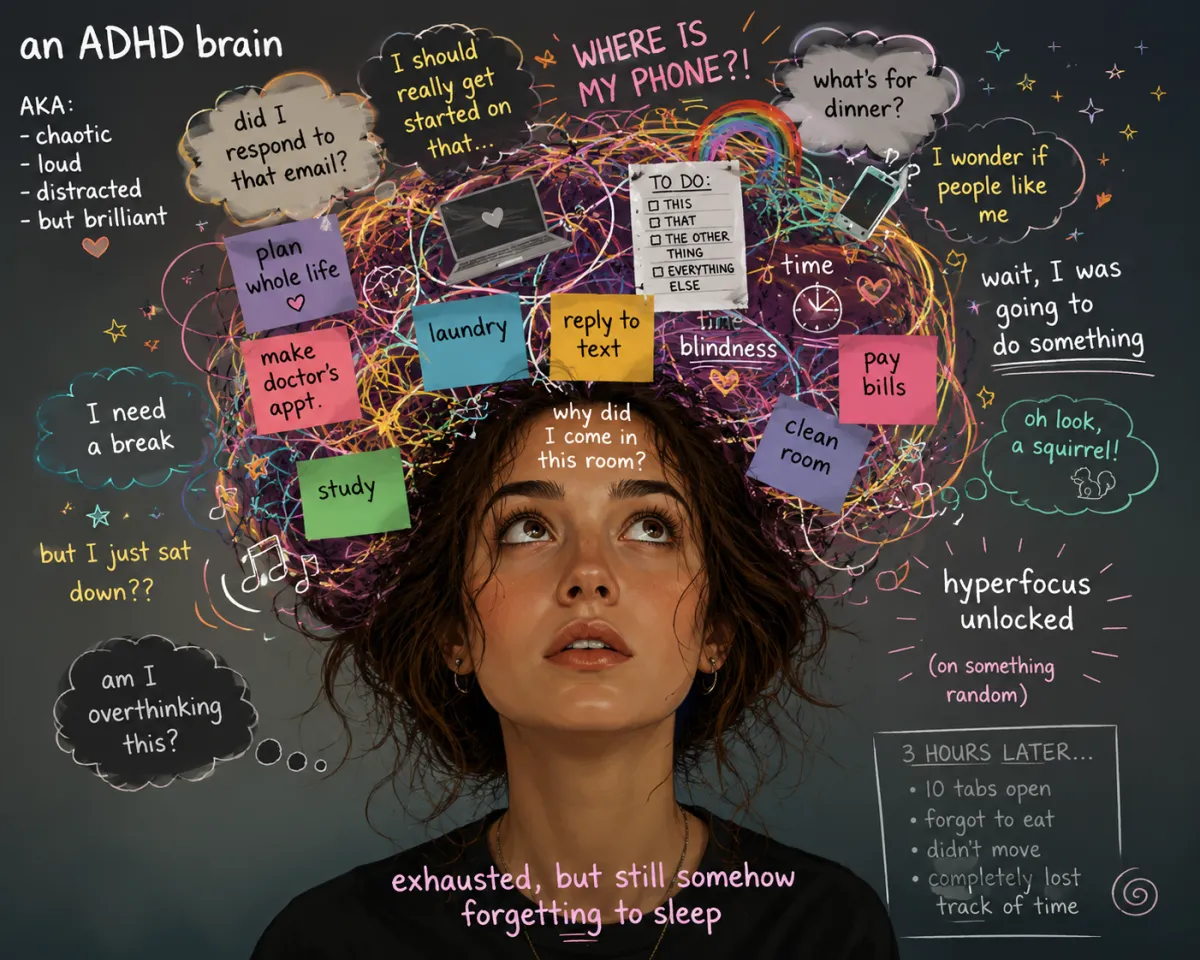
Is an ADHD Brain an Advantage in the Age of AI? An Honest Answer
The price of the things an ADHD brain is bad at is falling. The price of the things it is good at is rising. Whether that helps you depends entirely on what you build around it.
The short answer: An ADHD brain is not a superpower, and AI does not make it one. What AI does is cheaper and more specific than that. It does the exact kinds of work an ADHD brain pays the most for (starting, sequencing, holding the thread, grinding through the boring middle) for almost nothing. That shifts the value toward the things these brains tend to do well: generating ideas, chasing the odd connection, going deep when something is interesting. The advantage is real, but it only shows up inside a system. Without one, AI makes the worst ADHD habits cheaper too.
If you have an ADHD brain and you run a business, or want to, you have probably felt two things about AI at once. Relief, because something finally holds the thread you keep dropping. And suspicion, because you have heard "this is your superpower" before and it has never once paid a bill. This post takes both feelings seriously. By the end, you should be able to sketch what an AI setup looks like when it is built for a brain like this, and name the one way it goes wrong.
A note on where this is written from. Nobody has handed me a diagnosis. The pattern fits closely enough that I stopped arguing with it. If you want the clinical version, a CDC survey from late 2023, published in 2024, estimated 15.5 million U.S. adults, about 6 percent, had a current ADHD diagnosis, and about 56 percent of them were diagnosed as adults. This is a common brain. It is just rarely written about by people who build systems for a living and also live inside one.
What does AI actually do for a brain that struggles with executive function?
It moves the plan out of your head and into the place where the work happens, which is one of the longest-standing behavioral recommendations in the ADHD literature. The tools did not exist at the price they exist now. The principle did.
Russell Barkley, whose executive function model is one of the most influential in ADHD, describes ADHD as a problem of performance, not knowledge. People know what to do; the failure is doing it at the moment it needs doing. His prescription is to "externalize" the information the brain is supposed to hold internally, and to put it at the point of performance, the exact place and time the task happens. In his words, such externalized information "serves to cue the individual to do what they know". Posted rules, timers, checklists at the desk, rewards that arrive now instead of in a month. The whole toolkit is external scaffolding for a brain whose internal scaffolding is unreliable.
Read that through the lens of what an AI agent actually is. It holds context so you do not have to. It keeps a written sequence and runs it the same way every time. It prompts at a set hour whether or not you remembered. It does not care that the task is boring. It is, almost by definition, externalized executive function sitting at the point of performance. A morning report that runs at 6 a.m. and tells me what changed overnight is not a productivity trick. It is a working memory I do not have, placed where the day starts.
That is the mechanism, said out loud. Not "AI helps you focus." AI carries the specific load that executive function was supposed to carry, so the brain is free to do the part it was always better at.
Why does the price of ADHD's weaknesses drop when AI gets cheap?
Because the things ADHD brains pay the most for are exactly the things AI now does for almost nothing, and when the cost of a weakness collapses, the relative value of your strengths goes up. This is plain comparative advantage, not a motivational poster.
Think about what an ADHD brain is actually bad at, using Barkley's own list of executive functions: holding things in working memory, restraining impulses, motivating yourself through boring stretches, organizing across time. Now put AI next to each one.
| What an ADHD brain pays for | What an AI tool does cheaply | What stays scarce (and where it lives) |
|---|---|---|
| Starting (task initiation) | Drafts the first version so you edit instead of start | Deciding what is worth starting at all |
| Holding the thread (working memory) | Keeps the whole context and hands it back on request | Noticing the connection nobody asked about |
| Sequencing the steps | Runs a written sequence the same way every time | Knowing which sequence the business actually needs |
| Motivation through the boring middle | Does not get bored; 6 a.m. on a Tuesday is the same to it | Interest-driven depth on the hard problem |
| Time and deadlines | Runs on a schedule and reports without being asked | Judgment about what the report means |
Look at the right-hand column. Every row is some version of direction, judgment, or insight. When execution gets cheap, the bottleneck moves upstream to exactly those things. And those are the things an ADHD brain, on its good days, does well: generating options, jumping between domains, locking onto a problem for six hours because it became interesting. The market did not suddenly start valuing ADHD traits. It started valuing the upstream work because the downstream work stopped being scarce.
That is the honest version of the claim. Not "ADHD brains are better at AI." Rather: the cost of an ADHD brain's weaknesses is falling, and the price of its strengths is rising. The same shift is happening for everyone, which is why context switching is turning from a liability into a skill. It just happens to land harder, in both directions, on a brain built this way.
What does an ADHD brain do that AI still cannot?
It tends to generate ideas faster than it can finish them, to go unusually deep when interest catches, and to start things. The research on each is smaller and messier than the headlines suggest, so here it is without the spin.
On ideas: in Holly White and Priti Shah's earlier lab work, participants with ADHD scored higher on divergent thinking, and in a 2011 follow-up of 60 college students, those with ADHD reported more real-world creative achievement and preferred an "ideator" style (generating new ideas) over clarifying and developing them. That study is in Personality and Individual Differences. A 2020 review of 31 studies found the divergent-thinking advantage most consistently in people with high ADHD traits short of a clinical diagnosis, and generally not in people with the diagnosis itself, found no advantage in convergent thinking, and found that creative achievement ran high in both clinical and subclinical groups. So: real, not universal, strongest on the idea-generation end, and stronger in the trait pattern than in the diagnosis.
On depth: hyperfocus, the state of being completely absorbed in one task to the exclusion of everything else, is a routinely reported ADHD experience that researchers have only recently started defining and measuring; Ashinoff and Abu-Akel's 2021 review calls it "the forgotten frontier of attention." Anyone who has lived it knows the catch. It is interest-gated. It does not arrive on request, and it does not arrive for invoicing.
On starting: a 2019 study of 9,869 Dutch university students found a self-reported ADHD diagnosis associated with both entrepreneurial intention and entrepreneurial action, meaning those with a diagnosis were more likely not just to want to start something but to actually start it. Students, self-report, association rather than cause, but the direction is consistent with what anyone who has lived it would guess.
Notice the pattern in all three. Ideas, depth, and starting. None of them is the grind. AI can spray options all day, but it cannot supply the interest-driven depth, the judgment about which idea matters, or the impulse to actually begin. AI is very good at the grind. That is the whole argument in one paragraph.
Where does this go wrong?
It goes wrong the moment AI makes starting cheaper, because for an ADHD brain, starting the new and interesting thing was never the problem. Starting the boring task, and finishing anything, was. A tool that lowers the cost of beginning fifteen things is a gift to a brain that struggles to close two. Anyone who tells you otherwise is selling the shooting-up moment and skipping the root system.
The entrepreneurship research says this plainly if you read past the headline. A 2025 meta-analysis of 47 studies found that hyperactivity and impulsivity are positively related to entrepreneurial attitudes and behaviors but not to what happens after launch, that inattention is negatively related to post-launch outcomes, and that total ADHD symptoms and diagnosis are positively related to entrepreneurial behavior and negatively related to outcomes. ADHD gets the business started. It does not, by itself, keep the business alive.
Now hand that brain a tool that removes friction from starting. The failure modes are predictable, and I have run every one of them:
- Novelty on tap. New model, new tool, new agent framework, every week. Researching the stack becomes the work, and the stack never ships anything. The tell is a Saturday spent comparing tools and a Monday with nothing running.
- Hyperfocus on the wrong thing. Six hours building an elegant automation for a task that happens twice a year, while the follow-up that happens daily still runs on memory.
- Starting fifteen, shipping two. Every half-built system looks like progress in the folder and costs you the same as nothing in the bank.
- Mistaking the assistant for the system. This is the one that gets dressed up as a success story. A tool that answers when you remember to ask it is not a system. When someone says a team of AI agents runs their business, the question worth asking is what runs when nobody is typing.
So the honest position is that AI amplifies both ends. It takes the weight off the executive-function deficits and it lowers the guardrails on the starting impulse, and the meta-analysis says it is inattention, more than impulsivity, that does the damage after launch. Which end wins is not decided by the brain. It is decided by whether there is a system around it.
What does "inside a system" actually look like?
It looks like a small number of written sequences that run on a schedule, in one place, without waiting for you to feel like it. Not a dashboard of tools. A few boring things that happen the same way every time, so the interesting things have room.
Here is the shape of mine, not as a prescription, as a sketch you could draw on a napkin:
- One place where the state of the business lives, as plain files, so any tool can read the same record and nothing depends on what I remember.
- A handful of scheduled jobs. The morning report runs at 6 a.m. every day. A harvest job runs Sunday at 7 p.m. and pulls the week's activity into one place; a second job at 8 p.m. turns it into a plain-language readout. Nothing about those runs depends on my mood, my energy, or whether the week went well.
- Written sequences for the work that repeats: how a blog post gets produced, how a reel gets cut, how a new client's system gets mapped. The sequence lives in a file. The tool reads the file. The same steps run whether it is the first time or the fortieth.
- A rule about starting. Nothing new gets built until the thing it replaces is mapped, and the thing being built has a place in the map. That rule exists because of the failure list above, not in spite of it.
Notice what that setup does. It externalizes the four things Barkley said to externalize: working memory (the files), time (the schedule), rules (the written sequences), and motivation (the thing runs whether or not the brain shows up for it). The tools are ordinary. The architecture is the point, and it is the same architecture behind a system that runs without you in the room, whatever kind of brain is running the business.
If you want one thing to do this week, do this. Pick the single task you restart from scratch most often, the one where you re-figure-out the steps every time. Write the steps into a file, plainly, as if for a new hire. Then hand that file to whatever AI tool you already use and ask it to run the steps, not to advise you about them. You will have externalized one sequence at its point of performance. Everything else is more of that, in an order that fits your business, which is the part that deserves some help.
So is an ADHD brain an advantage in the age of AI or not?
Conditionally, yes, and the condition is not optional. The things these brains are bad at are getting cheap. The things they are good at are getting scarce. But the same tools that carry the weakness also lubricate the impulse, and the research on ADHD and entrepreneurship says the danger zone is after the start, not before it.
So the answer is not "you are built for this." It is closer to this: you are built for the upstream half of this, and the downstream half has to be built for you. A brain that generates, connects, and dives deep, sitting inside a scaffold of scheduled, written, boring sequences, is a genuinely strong combination right now. The same brain with a subscription to every new tool and nothing running at 6 a.m. is the old problem with better marketing.
The work that makes the difference is slow and invisible. Writing sequences. Mapping what already exists. Saying no to the fifteenth start. That is the root system under the part people see. Protect it.
Next steps
Before you add another tool, write down the one task you restart most often and turn it into a sequence a tool can run. If you want help figuring out which sequences to externalize first, and in what order, so the system holds the weight instead of your working memory, Bennin Systems maps that before anyone spends money on tools.
Frequently asked questions
Does AI make ADHD a superpower?
No. ADHD is a real impairment, and most of the research on it measures deficits, not advantages. What AI changes is the price of those deficits: starting, sequencing, holding context, and grinding through boring work are now cheap to hand off. That raises the relative value of idea generation, pattern-jumping, and interest-driven depth, which is a conditional advantage, not a superpower.
Do I need a diagnosis for any of this to apply?
No. The 2020 review of 31 studies found the divergent-thinking advantage most consistently in people who scored high on validated ADHD-trait scales without meeting full diagnostic criteria, and the CDC data shows about 56 percent of diagnosed adults were diagnosed after age 18. The practical advice, externalize the sequences, schedule the boring work, guard the starting impulse, applies to the trait pattern, diagnosed or not.
What is the single biggest risk of AI for an ADHD brain?
Cheaper starting. AI removes friction from beginning new things, and the meta-analytic research on ADHD and entrepreneurship shows ADHD helps people start ventures while hurting post-launch outcomes. A tool that makes fifteen starts easy, for a brain that struggles to close two, makes the core problem worse unless a system around it limits new starts and runs the repeatable work on a schedule.
What should I set up first?
One externalized sequence. Take the task you restart from scratch most often, write the steps into a plain file as if for a new hire, and have the AI tool you already use run those steps rather than advise on them. That puts the plan at the point of performance, which is one of the longest-standing behavioral recommendations in the executive-function literature, now at a price anyone can afford.
Is this the same as saying AI runs my business?
No. An assistant you remember to ask is not a system. A system is a small set of written sequences that run on a schedule, in one place, whether or not you feel like it. For an ADHD brain, that distinction is the whole thing, because the scaffolding has to hold when the motivation does not, and "AI runs my business" claims usually describe the assistant, not the scaffold.
Bennin Systems, Paradise Valley, Montana. (406) 224-3267. benninsystems.com
Stacy Bennin is the founder of Bennin Systems, where she builds the automated systems small businesses need but rarely have time to set up themselves: lead capture and follow-up that runs on its own, chatbots that answer questions and take orders around the clock, custom websites that act as an employee, and the back-office workflows that keep an operation from running on memory and sticky notes. Located in Montana, she works with businesses and real estate professionals anywhere in the United States. She is also a licensed Montana real estate broker affiliated with Legacy Lands Real Estate. Reach her at benninsystems.com.
