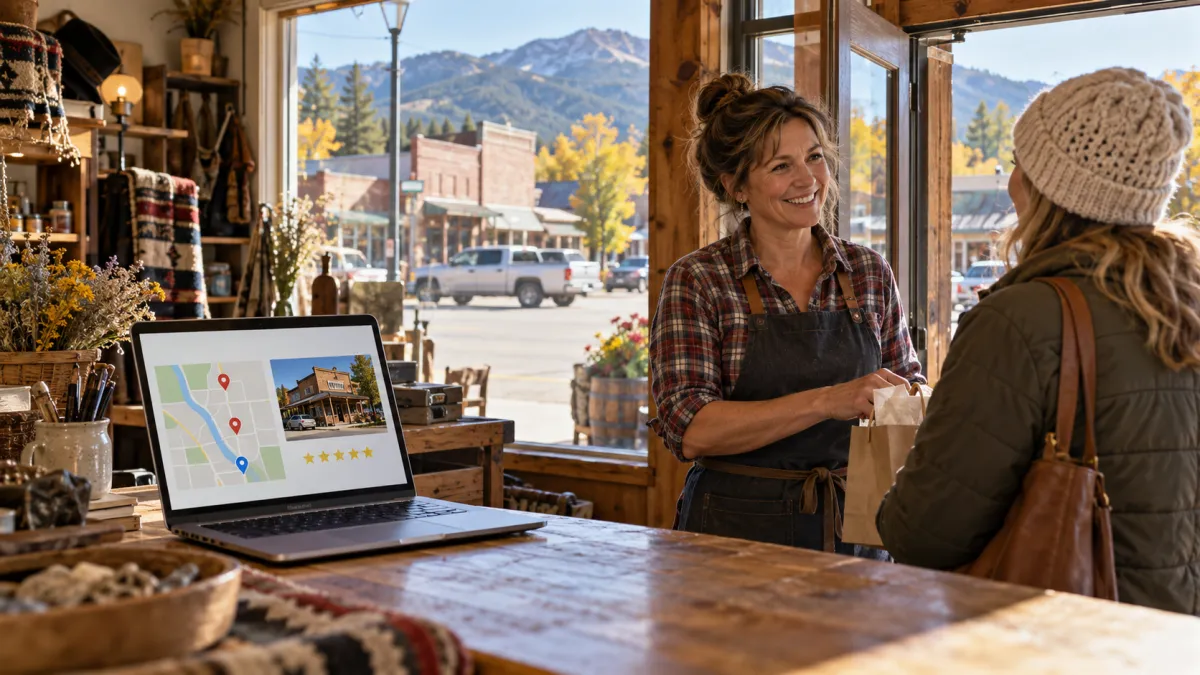
How Can Rural Montana Businesses Compete With National Brands?
The national company has the ad budget. You have the county. On the searches that turn into work, the county counts for more.
You run a business somewhere in Montana with a crew you can count on one hand, and when someone types your trade into a phone, a national company with a call center and a marketing department shows up above you. The question under that is fair: can a shop of four compete online with a company of four thousand?
This post is for the owner asking it, whether the shop is in Livingston, Lewistown, Dillon, or a town with one stoplight. The short answer is yes, on the ground that matters most: the customer within driving distance, asking a specific question, ready to hire. You will get a plain picture of where national companies win, where they lose, the five proofs of being local that no national company can fake, and three checks to run this week with what you already have.
Can a small Montana business compete online with national companies at all?
Yes, on local searches, and local searches are where most of your work comes from. Google's own help page says local results are based mainly on three things: relevance, distance, and prominence. Two of those three favor the business that is here, and Google states plainly that there is no way to pay for a better local ranking.
Read that page once, because it changes the fight. Google's guide to local ranking defines distance as "how far each business is from the customer who's searching." A national brand cannot move closer to Paradise Valley by spending more. It can buy ads, and the ads will sit in and above the results, labeled as ads. The ranking itself is another matter: the same page says there is "no way to request or pay for a better local ranking on Google."
Montana is also a state where the small operator is the normal case, not the exception. The SBA's 2026 small business profile for Montana's congressional districts reports that District 1, in the western part of the state, led the nation in small business share of employment at 70.4 percent (the SBA counts firms under 500 employees as small). In that district, 18,460 of 20,799 employers had fewer than 20 employees, using 2022 Census business data. When the customer searches, most of the businesses they could hire look like yours.
So the question is not whether you can outspend anyone. You cannot, and you do not need to. The question is whether the machines that answer local searches can find enough proof that you exist, that you are close, and that people trust you.
Where do national companies win, and where do they lose?
National companies win on budget, volume, and polish: paid placements, thousands of reviews, a website a team maintains, and a phone answered at midnight. They lose on distance, on local knowledge, and on the specific question, because none of those can be bought from headquarters. Pick your ground on purpose.
| Ground | National company | Local Montana business |
|---|---|---|
| Paid ads at the top of search | Wins. It can outspend you on any keyword | Does not need to fight here |
| Distance to the person searching | Often an office or franchise hours away, or none | Wins. You are here, and Google weighs distance |
| Review volume | Wins on raw count across the whole country | Wins on recent reviews from people in your county |
| Answering the specific local question | Generic pages written for every market at once | Wins. You know the roads, the season, the county rules |
| Phone answered after hours | Wins with a call center | Can close the gap with a system that answers and books |
| One name and number everywhere | Usually consistent; a team manages it | Often the weak spot, and fixable in an afternoon |
Two rows are worth a second look. The after-hours phone is the one place a national company's size buys a real advantage, and it is also the one a small operator can close with a system instead of a hire. The last row is where local businesses most often lose ground they should own, which is why it gets its own section below.
What are the five proofs a national company cannot fake?
Call them the five local proofs: a place on the map, one name everywhere, recent reviews in your customers' words, answers only a local could give, and a person who responds. Most map to what Google says it weighs, and each is something a national brand can imitate only by opening a real location here.
Here is what each proof looks like, and what the search systems read from it.
| Proof | What the customer sees | What the search system reads | How to check it |
|---|---|---|---|
| 1. A place on the map | Your pin, or your service area, on the map | Distance, from a verified profile | Search your trade and town on a phone; are you on the map? |
| 2. One name everywhere | The same name, phone, and address on every page | Listings it can tie together as one business | Compare your profile, site footer, and Facebook line by line |
| 3. Recent reviews in their words | Neighbors describing the job and the place | Prominence, and the words people use for your work | Count reviews from the last three months |
| 4. Answers only a local could give | A page that answers their exact question | Relevance to the specific search | Does your site answer the three questions you hear most? |
| 5. A person who responds | A reply the same hour, from someone who knows the area | Nothing directly; this proof keeps the caller you already won | Call your own line after close; what happens? |
1. A place on the map. A verified business profile is the clearest way to tell Google where you are, which is what distance is measured from. If customers come to you, it shows your address. If you go to them, Google's profile guidelines tell service-area businesses to hide the address and name the area they serve instead. Either way, the profile is what puts you on the map. How your Google Business Profile affects whether you get found covers the profile in depth.
2. One name everywhere. Covered in the next section, because it is the proof most often broken.
3. Recent reviews in your customers' words. Covered below with the numbers.
4. Answers only a local could give. A national company's page about well drilling, roofing, or propane delivery is written once for every market. Yours can answer what the person in your county is typing: whether you work through the winter, which towns you cover, what the first visit costs, how long the wait runs in July. Relevance is the first of Google's three factors, and the only way to be relevant to a specific question is to have answered it somewhere a machine can read.
5. A person who responds. A national call center answers fast. It cannot answer with knowledge of the road to the property. When your phone goes to voicemail at 6 p.m., the caller tries the next result, and the next result is often the national number. A system that texts back a missed call and books the visit keeps the caller with the person who knows the ground.
For producers, restaurants, and retailers, there is an optional sixth: the state's Made in Montana program. Joining is free according to the membership page, qualifying products must carry 50 percent or more of their added value from work done in Montana, and state law (MCA 30-17-101) directs the Department of Commerce to keep an online directory of qualifying businesses. A national brand selling into the state cannot put that logo on a product made somewhere else.
Why does the same name everywhere matter so much?
Because search systems and AI assistants cross-check what is published about you. When your name, phone, address, hours, and website match across listings, the systems can treat them as one business with confidence. When they differ, the systems have to guess, and a business they have to guess about is easier to pass over.
Here is the mechanism, said plainly. Google has your profile, and it can also find your website, your Facebook page, directory listings, and other public records. If three of those say "Smith Plumbing & Heating," one says "Smith Plumbing LLC," and one carries an old phone number, the system has to guess whether those are one company or three. Google's own guidance on AI features tells site owners to make sure "structured data matches the visible text on the page" and to check that Business Profile information "is up-to-date." Accurate and matching information is a recurring theme in that guidance, and the same logic extends to every listing you control. What structured data is, and why AI needs it explains the label that tells machines your listings belong together.
Google's profile guidelines also say your business name should reflect your real-world name, "as used consistently on your storefront, website, stationery, and as known to customers." Keywords stuffed into the name field are against the rules, and they create a mismatch with every other listing.
This one catches careful people. When I checked my own company's filing with the Montana Secretary of State this summer, the principal address had the right street and the wrong town, a Bozeman city name paired with a Livingston zip code. Nothing looked wrong from inside the business. Every listing that pulls from that record inherits the error until someone corrects it. That is what a congruence problem looks like: small, invisible from your desk, and repeated everywhere a machine looks.
The directories worth checking are few. Your Google profile, your website footer and contact page, Facebook, Apple Business (formerly Apple Business Connect, which puts you on Apple Maps), Bing Places, and any trade directory your customers use. Name, phone, address or service area, hours, website address. Five fields, a handful of places.
How do reviews decide who wins a county trade market?
Reviews are part of the prominence Google weighs, and customers read them as proof. BrightLocal's 2026 survey found 47 percent of consumers won't use a business with fewer than 20 reviews, and 74 percent only care about reviews from the last three months. Recent beats a pile of old ones.
The numbers come from BrightLocal's Local Consumer Review Survey 2026, a panel of 1,002 U.S. adults. A few more from the same survey shape how to ask for reviews. The top factor people named was a review "backed up by other reviews with similar sentiment" (56 percent). Recency ranked third, with 44 percent weighing whether a review was posted within the last month. And 37 percent weigh whether the owner responded.
Read that list as a local business. A national chain's review total is spread across hundreds of locations and years. What the person in your county reads first is the recent handful. Ten reviews from this summer, each naming the job and the town, outweigh a national count that says nothing about the road to their house.
The difference shows up fast in a real market. In August, before calling a painting contractor in the Gallatin Valley, I ran a full check on the business: a profile rated 4.9 across more than a hundred reviews, an owner who had answered every one, a booking button, posts from the month before, and a website with a quote form on most of its pages. I took it off the call list, because someone competent was already doing the work. In the same market, the common version of a trade business looks like this: an unclaimed profile, a few old reviews, no photos. Same county, same trade, the same distance from the customer. One of them gets the call.
The owner's reply counts too, and it is the easiest of the three to control. A short, specific response to every review, good or bad, in the owner's own words, is proof that a person runs the place.
Does AI change the math for a small local business?
It raises the stakes on the same work rather than adding new work. BrightLocal found use of ChatGPT and similar tools for local recommendations rose from 6 percent to 45 percent in a year. Google says there are no special files or markup needed to appear in its AI features; the fundamentals decide.
That BrightLocal finding made AI tools the third most popular source of local business recommendations in 2026, behind Google and Facebook. The same survey found people use an average of six review sites. Both point the same way: the customer is assembling an answer from several places, and so is the assistant they ask.
An assistant answering "who pumps septic tanks near Big Timber" is summarizing what it can find and trust. It likely draws on the same kind of public record Google does: profiles, reviews, your site, directory listings. If that record is thin or contradictory, the assistant tends to name whoever has a clearer one, and in a small town that can be a national lead service with a clean page for every zip code. Why AI doesn't recommend your business when customers ask walks through that failure in detail.
Google's developer documentation is direct about what it takes: "There are no additional requirements to appear in AI Overviews or AI Mode, nor other special optimizations necessary," and "You don't need to create new machine readable files, AI text files, or markup to appear in these features." Anyone selling you a special AI file for Google's search features is selling you something Google says you do not need. The five proofs above are the work. What Montana businesses should know about AI in 2026 covers the rest of the ground for owners here.
What can you do this week with what you already have?
Three checks, a few hours at most, no purchase. Search your own trade and town from a phone the way a stranger would. Line up your name, phone, and address across every listing and fix the mismatches. Then ask your three most recent customers for a review that names the job and the town.
- Search yourself as a stranger. On a phone, signed out of your accounts or in a private window, search your trade plus your town ("plumber Livingston MT"), then ask one AI assistant the same question in a full sentence. Write down who appears, in what order, and whether you appear at all. That list is your real competition, and it is usually shorter than you fear.
- Line up the five fields. Open your Google profile, your website footer, your Facebook page, and your record in the Montana Secretary of State's business search. Compare name, phone, address or service area, hours, and website address, character for character. Fix every mismatch you control today, and write down the ones you do not.
- Ask three people. Text your three most recent customers a short thank-you and a direct link to your review page, and ask for an honest review. No incentives, and no asking only the happy ones; Google's review policies prohibit both. Suggest they mention what you did and where ("replaced the pressure tank at our place outside Emigrant"). Specific reviews help the next customer and tell the search system what you do and where you do it.
None of this needs software. It needs someone to do it on purpose and keep doing it. The part that benefits from a system is the part that has to happen every week: asking every customer, answering every review, catching every after-hours call, and keeping the listings matched when something changes.
What does competing locally cost, and what won't it fix?
It costs steady attention more than money: a few hours to line things up, then a small weekly habit. It will not win generic national searches, it will not beat paid ads above the results, and visibility alone will not bring work if nobody answers when people reach out.
The honest tradeoffs:
- It is slow. Reviews accumulate one job at a time. Local relevance builds over months, not days. Nothing about this is a switch. It is the root system growing before anything shows above the ground.
- You will not win "best roofer." Broad searches with no place attached belong to the biggest brands and the best-funded aggregators. Let them have it. Your customer types a town.
- Visibility is half the job. Being found only matters if the person who finds you can reach you. A Southwest Montana real estate business I work with had a blog drawing readers for months, and a June review of its customer records found that every inquiry had come from a page with a form and an offer, not from the articles. Being found is the first half. A door that captures the person and a reply that reaches them fast is the second.
- Some of it needs upkeep. Hours change, phone numbers change, a directory copies an old address. The five fields drift unless someone owns them.
The ground you already hold
A national company can outspend you on every keyword in Montana and still cannot be twenty minutes from your customer, cannot know which county road washes out in April, and cannot collect a review from your neighbor for work it did not do. That ground is yours already. The work is making it visible to the machines that now stand between you and the person searching, and protecting it once it is.
Bennin Systems builds that layer for local businesses: the listings lined up and kept matched, the review request that goes out after every job, and a system that answers and books when the phone rings after close. The owner keeps doing the work only a local can do.
Frequently Asked Questions
Can a small Montana business outrank national companies on Google?
On local searches, often yes. Google says local results depend on relevance, distance, and prominence, and that there is no way to pay for a better local ranking. A nearby business with a verified profile, consistent listings, and recent reviews can appear above a national company that has no location near the person searching.
Do national companies win because they spend more on advertising?
They win the paid ad slots, which are labeled as ads. Google says there is no way to pay for a better local ranking; it ranks local results mainly by relevance, distance, and prominence. Ad spending does not move a national brand closer to a customer in a rural county.
How many reviews does a local business need to compete?
BrightLocal's 2026 survey found 47 percent of consumers won't use a business with fewer than 20 reviews, and 74 percent only care about reviews from the last three months. A steady flow of recent reviews that name the job and the town matters more than a large old total.
Why does my business name need to match everywhere?
Search systems and AI assistants cross-check what is published about you. When your name, phone, address, hours, and website match across your profile, website, social pages, and directories, they can treat the listings as one business with confidence. Mismatches force a guess.
Do I need special files or markup for AI search?
No. Google's documentation says there are no additional requirements or special optimizations to appear in AI Overviews or AI Mode, and no new machine-readable files or AI text files are needed. Keep your profile current, make sure structured data matches the visible page, and follow the fundamentals.
How are people using AI to find local businesses?
BrightLocal's 2026 survey found use of ChatGPT and similar tools for local recommendations rose from 6 percent to 45 percent in a year, making AI the third most popular source behind Google and Facebook. Assistants build answers from public profiles, reviews, and websites, so a clear local record helps.
What is the Made in Montana program, and who can use it?
It is a free Montana Department of Commerce program for products made, grown, or enhanced in the state with 50 percent or more of their added value created here. Producers can use the logo on qualifying products, retailers and restaurants can join too, and state law directs Commerce to keep an online directory of qualifying businesses.
What should a rural business do first to compete online?
Search your trade and town from a phone the way a stranger would, and note who appears. Then match your name, phone, address, hours, and website across your Google profile, website, Facebook, and state business record. Then ask your three most recent customers for an honest review that names the job and town.
Stacy Bennin is the founder of Bennin Systems, where she builds the automated systems small businesses need but rarely have time to set up themselves: lead capture and follow-up that runs on its own, chatbots that answer questions and take orders around the clock, custom websites that act as an employee, and the back-office workflows that keep an operation from running on memory and sticky notes. Located in Montana, she works with businesses and real estate professionals anywhere in the United States. She is also a licensed Montana real estate broker affiliated with Legacy Lands Real Estate. Reach her at benninsystems.com.
Bennin Systems · Paradise Valley, Montana · (406) 224-3267 · benninsystems.com
