What Does Owning Your Data Actually Mean for a Small Business?
Ownership is a sentence in a contract. Possession is a copy you can open today. Only one of them survives a bad week.
The short answer: Owning your business data means you can produce a complete, usable copy of it today, without asking permission and without anyone at your vendor helping you. Almost every contract already says the data is yours. Very few of them guarantee you can reach it.
Microsoft's own Services Agreement, effective September 30, 2025, states both halves of that gap in the same document. "Your Content remains yours and you are responsible for it." And a few clauses later: "You should have a regular backup plan as Microsoft won't be able to retrieve Your Content or Data once your account is closed."
Both sentences are true. They describe two different things. One is a claim. The other is a condition.
If you have read the Bennin Systems posts on where your business data lives or owning your presence instead of renting attention, this is the version with the abstraction taken out. Not the principle. The test.
What does "owning your data" actually mean?
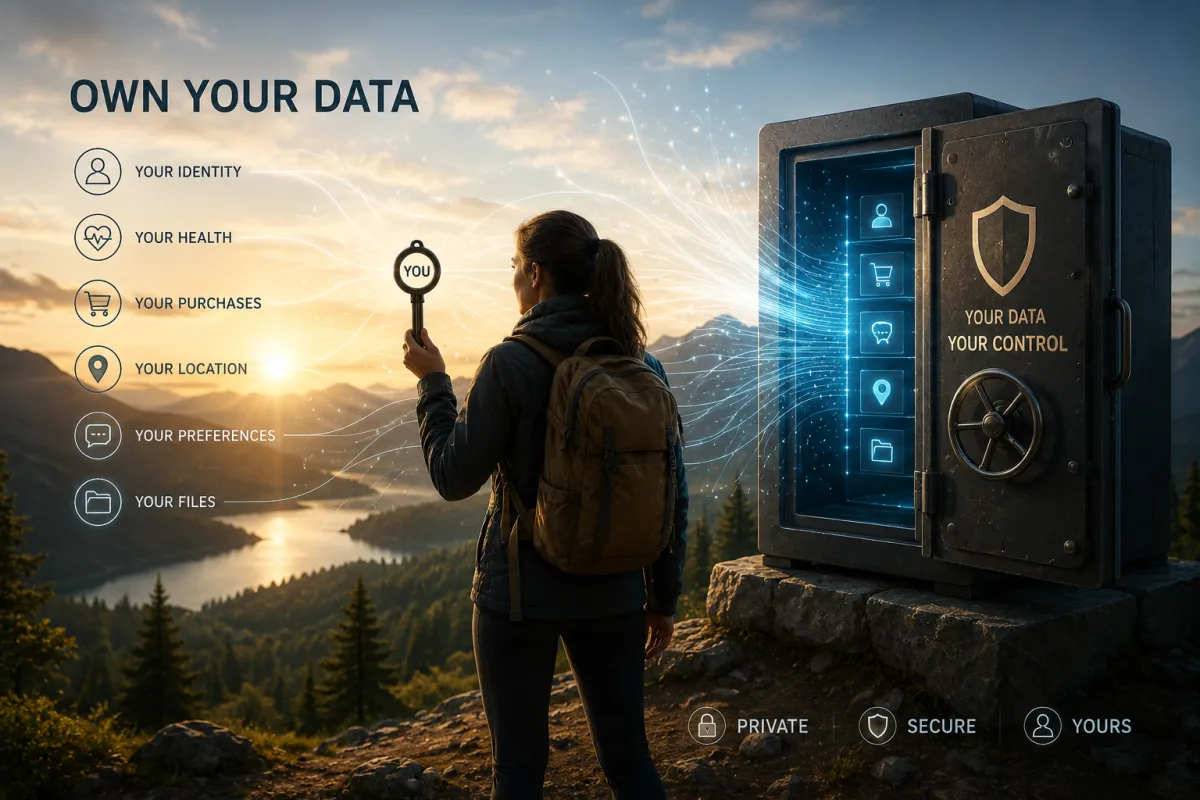
Owning your business data means three things at once: a current copy exists somewhere you control, that copy contains everything and not just the convenient parts, and you can decide who else sees it. Miss any one of those and you have a license, not ownership.
The phrase gets used loosely, usually by people selling something. It sounds like a value, and values are hard to check. So here is the version you can check.
Legal ownership is cheap. Nearly every platform grants it, because granting it costs the platform nothing. What costs the platform something is making it easy for you to leave, which is why the export tools tend to be thinner than the import tools.
A contract that says the data is yours is not the same as a copy of it on a drive you control. One of those helps you on a Tuesday when the account is locked.
Why isn't "it's in the cloud" the same as owning it?
Cloud storage is a location, not a guarantee. The provider is responsible for keeping the service running. You are responsible for keeping a copy of what is inside it. That split is standard across the industry, and most owners never read the part of the agreement where it is spelled out.
Google says it plainly in the admin documentation for cancelling Google Workspace: "Before you cancel your Google Workspace subscription, download any user data you want to save," followed by "After you cancel your Google Workspace subscription, your users' Google Workspace data will be deleted and can't be restored."
Read that as an operator, not a customer. The instruction is not hostile. It is honest. The company is telling you that the copy on their servers is theirs to delete once the relationship ends, and the copy that survives is the one you made.
Cancellation is only the loudest version. The quieter ones are a card that expires while you are traveling, a suspension over a billing dispute, an account recovery that takes eleven days, or an employee who left with the only admin login. Each of those leaves the ownership clause fully intact and your business fully stopped.
What four questions tell you whether you own your data?
Four questions settle it. Can you produce a copy today without asking anyone? Does that copy include everything, not just the easy layer? Is what comes out usable by another system? Do you control who else can see it and what it gets used for? Four yeses is ownership. Anything less is access.
These are the questions Bennin Systems runs on any platform before a client's business gets built on top of it. They take about ten minutes to answer and they are uncomfortable in a useful way.
1. Possession. Not "can I export," but "have I." An export button you have never pressed is a fire extinguisher still in the box. The question is whether a current copy exists right now, in a place you control, that you could open if the vendor disappeared tonight.
2. Completeness. Most platforms will hand over the contact records. Fewer will hand over the conversation history, the call recordings, the uploaded files, the form submissions, and the automation logic that connects them. A business is not just its list. It is the list plus everything that happened.
3. Usability. A PDF of your customer records is technically an export. It is not data. The test is whether another system could load what came out without a human retyping it.
4. Control. Who else can see this, and what is it being used for. That answer lives in the terms of service, and the terms of service change on a schedule you do not set.
| The question | What renting looks like | What owning looks like |
|---|---|---|
| Can you produce a copy today? | You would need to find the button, request an export, or open a ticket | A current copy already exists somewhere you control |
| Does the copy include everything? | Contacts come out. History, files, recordings, and automation logic often do not | Every layer comes out: records, history, attachments, and the connections between them |
| Is what comes out usable? | A report or a PDF that loses the relationships between records | A structured file another system can load without a rebuild |
| Do you control who sees it? | The terms of service decide, and they get revised | You decide, and you can show where the copy is |
Who is actually responsible when your data goes missing?
You are. Not the vendor holding it. Both tax law and most state breach law assign the obligation to the business that owns the records, regardless of whose server they were sitting on when something went wrong. Ownership follows you even when possession does not.
Washington's breach statute, RCW 19.255.010, is representative of how most states structure this. Subsection (2) requires any business holding personal information it does not own to notify the owner of a breach immediately following discovery. The duty to notify the affected people stays with the owner. Your vendor tells you. You tell everyone else.
The IRS draws the same line. Publication 583, revised December 2024, opens with "Everyone in business must keep records," specifies that "All requirements that apply to hard copy books and records also apply to electronic storage systems that maintain tax books and records," and instructs that records be kept "as long as they may be needed for the administration of any provision of the Internal Revenue Code."
Nothing in there is conditioned on your software still working. This is the part that catches people. The obligations of ownership transfer to you automatically. The capabilities of ownership do not.
Does the law give a small business a right to its own data?
In the United States, mostly no. The well-known data rights belong to individuals, not to companies. A business asking for its own records from a vendor is generally asking under a contract, not a statute, which means the answer depends on what someone agreed to years ago.
Article 20 of the GDPR gives the right to receive personal data in a structured, commonly used and machine-readable format to the data subject, meaning the individual person. California's equivalent sits inside the consumer right to know. Civil Code 1798.130(a)(2)(A) requires disclosure "in a readily useable format that allows the consumer to transmit this information from one entity to another entity without hindrance." The consumer. Not the business that hired the software.
The one real business-side switching right is European. The EU Data Act has applied since September 12, 2025, requiring cloud providers to remove contractual and technical barriers to switching, and switching charges are phased out entirely from January 12, 2027. There is no broad United States equivalent, federal or otherwise.
So for a business in Montana, or Ohio, or anywhere else in the country, the practical answer is that your right to your own data is whatever your vendor's terms say it is, plus whatever copies you kept. That is not a scandal. It is just the actual condition, and it is better to know it than to assume a protection that is not there.
What does this look like for a business of one to ten people?
At this size the whole thing usually rests on one person's memory and two or three logins. The exposure is not dramatic. It is that nobody has ever tested whether the business could reconstruct itself from what it actually holds, and the test costs almost nothing to run.
Say a three-person office runs its customer records in one platform, its invoices in a second, its files in a third, and its phone system in a fourth. Each of those relationships is fine. None of them is the problem. The problem is that no single person can answer where the current copy of the customer history lives, and the answer turns out to be nowhere, because the platform holds the only one.
That office does not have a technology problem. It has an ownership problem wearing a technology costume, and it will stay invisible until the week it is not.
What Bennin Systems builds for clients is the version where that question has an answer. Nancy Clark's real estate system holds the pipelines, the conversations, and the follow-up in one place her business controls, rather than scattered across four vendors with no complete copy anywhere. Emma, the ordering assistant running for Scotty's Oil, captures orders and routes them into a system the family owns, so a phone call becomes a record instead of a note that depends on somebody remembering.
Neither of those is a backup strategy. They are the same idea one level up: the business holds its own operating record, and the tools are tenants in it rather than landlords of it.
What is the honest tradeoff of owning your data?
Owning costs more, in money and in attention. Renting is genuinely the right call for plenty of things, and a vendor holding your data is not automatically a bad vendor. The tradeoff is real: you trade convenience for control, and control comes with maintenance nobody else will do for you.
Here is the honest version. If you are one person with a contact list of two hundred names and a calendar, a monthly export you actually keep is probably the entire answer, and building anything more elaborate would be a hobby. The math changes when the business starts depending on history, when more than one person needs the same record, or when the cost of reconstructing six months of context stops being a bad afternoon and starts being a bad quarter.
There is also a failure mode on the ownership side, and it should be said out loud. A system you own and never maintain is worse than a rented one somebody else patches. Ownership without upkeep is just a slower version of the same problem, which is why systems bolted on and abandoned break about as reliably as ones you never controlled.
The bottom line
Owning your business data is not a philosophy. It is four checkable conditions, and most small businesses fail at least two of them without knowing it.
The word "own" in a terms of service agreement is doing legal work, not operational work. It tells you who has the claim. It says nothing about whether you could exercise that claim on a Tuesday morning with a locked account and a customer on the phone. Those are separate facts, and the second one is the one your business actually runs on.
None of this requires alarm. It requires an inventory, which is a smaller and much more boring thing than most people expect.
Next steps
Pick the one platform your business would hurt most to lose, and answer the four questions about it out loud. Not "could we export this" but "when did we last, where is that file, and does it include the history." Ten minutes, one tool. The answer will tell you whether you have an ownership problem or just an untested assumption.
If mapping that out for your whole operation is the part that keeps getting postponed, Bennin Systems can walk the stack with you and show you where the real gaps are before anything gets built or bought. Understanding whether your tools fit the way you actually work is the same conversation from a different angle.
Frequently Asked Questions
What does it mean to own your business data?
It means a current, complete copy of your business records exists somewhere you control, in a format another system could use, and you decide who else sees it. Legal ownership stated in a contract is only one part. Without possession and usability, ownership is a claim you cannot exercise.
If my contract says the data is mine, do I already own it?
Not operationally. Microsoft's Services Agreement says "Your Content remains yours and you are responsible for it" and also warns that Microsoft cannot retrieve your content once the account is closed. Both are true. The contract settles who has the claim, not whether you can reach the data.
Is data stored in cloud software backed up automatically?
Not in the way most owners assume. Providers protect their infrastructure and service availability. Keeping a retrievable copy of your own records is generally your responsibility, which is why Google instructs administrators to download user data before cancelling a Workspace subscription rather than after.
Does the law require a vendor to hand over my business data?
In the United States, generally no. GDPR Article 20 and California's Civil Code 1798.130 grant portability rights to individuals and consumers, not to businesses using software. The EU Data Act creates a genuine business switching right in Europe, applicable since September 12, 2025, with no broad US equivalent.
Who has to notify customers if my vendor gets breached?
You do, in most states. Washington's RCW 19.255.010 is typical: a company holding personal information it does not own must notify the owner of the breach, and the owner carries the duty to notify the affected people. The obligation follows ownership, not possession.
What is the difference between exporting data and owning it?
An export is an event. Ownership is a standing condition. A business that could export but never has does not own its data in any practical sense, because the copy does not exist yet and the ability to make one depends on the account still working.
How often should a small business export its own copy?
Often enough that losing everything since the last one would be an annoyance rather than an emergency. For most small operations that means monthly at minimum, and more often once the business depends on conversation history and files rather than just a contact list.
Is this worth worrying about with only a few employees?
Smaller businesses carry more concentration risk, not less, because one platform usually holds a larger share of the operation and one person usually holds the only login. The fix scales down with you. For a one-person business, a kept monthly export may be the entire solution.
Bennin Systems, Paradise Valley, Montana. (406) 224-3267. benninsystems.com
Stacy Bennin is the founder of Bennin Systems, where she builds the automated systems small businesses need but rarely have time to set up themselves: lead capture and follow-up that runs on its own, chatbots that answer questions and take orders around the clock, custom websites that act as an employee, and the back-office workflows that keep an operation from running on memory and sticky notes. Located in Montana, she works with businesses and real estate professionals anywhere in the United States. She is also a licensed Montana real estate broker affiliated with Legacy Lands Real Estate. Reach her at benninsystems.com.
