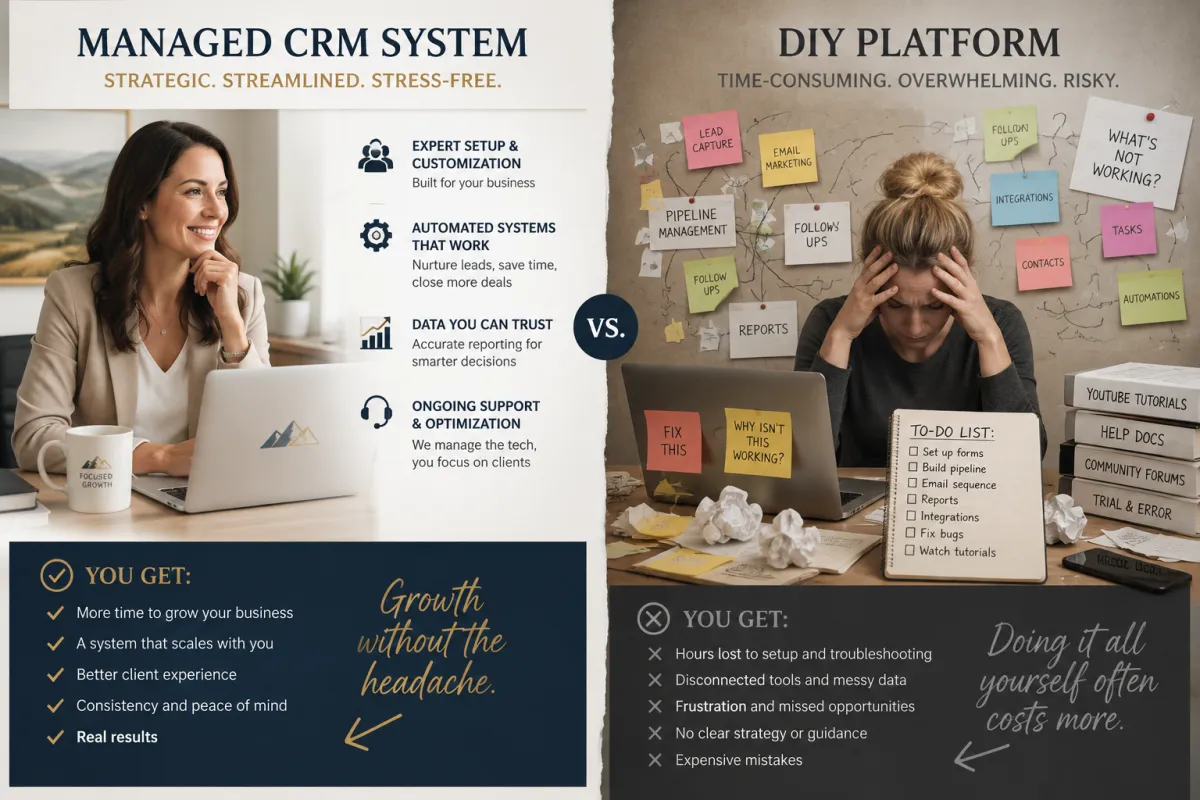
What's the Real Difference Between a Managed System and a DIY Platform?
Every vendor shows you exactly one of these options. Here's the comparison none of them put on the pricing page.
The short answer: A DIY platform sells you capability and leaves the building to you. A managed system sells you the outcome and keeps most of the control. Neither is wrong. The problem is how they're sold: platform companies never mention the hundreds of hours of building and maintenance you just signed up for, and agencies rarely mention that you could own the thing yourself. The right answer depends on your volume, your time, and your appetite for maintenance. And there's a third option almost nobody offers, which is a system built for you that you actually own.
Here's the honest side-by-side before anything else:
What do "managed" and "DIY" actually mean here?
DIY means you subscribe to a platform (a CRM, an all-in-one marketing suite, an automation tool) and build your own workflows inside it. Managed means a company runs the system for you: they build it, host it, maintain it, and you consume the results. The definitions are simple. The sales process is where it gets murky.
Notice something about how these get sold. The platform's pricing page shows you a monthly number and a feature grid. It does not show the time it takes to make those features do anything. The agency's proposal shows you deliverables and a retainer. It does not show what happens to your operation if you stop paying. Each side prices what it's good at and stays quiet about the rest.
Most owners never see both options laid out honestly side by side. They meet whichever salesperson found them first. That's the actual reason this comparison is worth your time: not because one option is a trap, but because choosing between them without seeing both cost structures is how businesses end up on the wrong side for years.
What does DIY actually cost you?
The subscription is the smallest number involved. The real price of a DIY platform is your hours, and they get spent in three places: building the thing, learning the thing, and maintaining the thing. The platforms we deploy for clients typically run between about $100 and $500 a month. The time is where the money is.
Take one small piece of the job as a measuring stick. Orbit Media's 2025 survey of 808 content marketers found the average blog post takes just under three and a half hours to write. That's one post, by people who do it professionally, and it doesn't count the platform work around it: the templates, the email sequence, the form that captures the reader, the automation that follows up. Multiply that honest number across everything an all-in-one platform promises and the subscription starts looking like the cheapest part of the arrangement.
Then there's the capability you pay for and never touch. Zylo's 2026 SaaS Management Index, drawn from more than 40 million software licenses, found organizations leave an average of 36 percent of their licenses unused. Those are mostly large companies with IT departments whose whole job is adoption. A solo operator with a 40-feature platform and a business to run doesn't beat that number, and there's no shame in it. There are only so many evenings.
The part nobody prices at all is maintenance. Workflows drift, integrations change, and a system nobody owns the upkeep of degrades quietly. We wrote about why small business automations tend to break within six months, and the short version applies double to DIY: the build is an event, but the maintenance is a job. If nobody holds that job, the platform slowly returns to being an expensive contact list.
None of this means DIY is wrong. It means DIY is a real commitment of your scarcest resource, and the pricing page will never say so.
What do you give up with a fully managed service?
Control, speed, and sometimes your own system. When everything runs through someone else, every change has a ticket and a timeline. The deeper risk is structural: if the vendor hosts the accounts, owns the logins, and holds the workflows, the thing running your operation isn't yours. It's theirs, rented to you.
Managed done well is a genuinely good deal for a busy operation. Real work gets done by people who do it every day, and your evenings stay yours. Plenty of vendors are worth every dollar. The picture Content Marketing Institute's 2026 B2B research shows is of businesses leaning further in, with 19 percent planning to increase their agency and outsourcing investment in 2026.
But two things deserve your open eyes before you sign.
First, the exit. Ask what you keep if you leave: the contact list, the automations, the content, the accounts themselves. Some contracts make leaving clean. Others make it expensive on purpose. Regulators have started noticing this pattern in cloud services generally, and the EU's Data Act now requires providers there to make switching feasible, with switching charges phasing out entirely by early 2027. There's no broad equivalent protecting a U.S. small business, so your protection is the question you ask before signing, not a statute. The principle behind owning your online presence instead of renting attention applies to your operations layer too.
Second, the dependency posture. A vendor who explains what they built, shows you where things live, and teaches you what you could handle yourself is a partner. A vendor who keeps everything vague so you feel incapable of leaving is running a retention strategy on you. Needing help is normal. Being kept helpless is a business model, and it's the one worth walking away from.
Which one fits which business?
Volume and time decide this, not sophistication. The verdicts, plainly:
DIY fits you when the workload is genuinely small (one capture point, one follow-up sequence), you have real hours to give it every month and not just at setup, and you're the kind of owner who actually enjoys the building. A business with one clear use case doesn't need a managed anything.
Managed fits you when the system touches revenue daily, your hours are worth more in the work only you can do, and you've verified the exit terms. A busy service business with calls, bookings, follow-ups, and reviews in motion loses more to a half-built DIY setup than a good managed fee costs.
Neither fits you when the tool doesn't match how you actually work. We covered this in Does the Tool Fit How You Actually Work, or Are You Bending to Fit It?, and it's the prior question. A managed subscription to the wrong system is just outsourced friction, and businesses will stay on software that no longer serves them for years because the switching feels harder than the suffering.
When should you pick neither?
Two honest cases. If your volume is low enough that a phone and a notebook genuinely keep up, keep the money. A business with a handful of inquiries a week doesn't need a platform or an agency; it needs to answer the phone well, and that's free. Buying infrastructure ahead of the need is how shelfware happens.
And if your volume is high enough, the real alternative to both is a person. The SBA's long-standing rule of thumb puts a hire's true cost at 1.25 to 1.4 times salary once taxes and overhead land. That's real money, and past a certain scale it buys something no platform or retainer does: a human who notices things. The honest math isn't platform versus agency. It's platform versus agency versus person versus nothing, and pretending the last two aren't on the menu is how vendors keep the conversation small.
What's the third option nobody sells?
A system built for you that you own when it's done. The build gets done by someone who has done it before, the way a managed service would do it. But the accounts are yours, the logins are yours, the workflows live where you can see them, and you get taught how to run what was built. The dependency ends on purpose.
That's the model Bennin Systems runs, and the order matters: map the process, build the system, then teach you to run it. The chatbot that takes orders around the clock for a Florida oil company, and the full pipeline-and-follow-up system behind a Montana broker's operation, were both built that way. The owners aren't platform experts and don't need to be. They can see their own machinery, and if we disappeared tomorrow, everything keeps running and belongs to them, and they know enough to keep it that way.
The reason this option is rarely offered is simple enough: it ends the retainer's leverage. A vendor whose clients can leave has to stay valuable instead of staying necessary. That trade seems fair to us.
So before you sign either contract this quarter, do one thing: write down what you'd keep if you canceled after a year. If the DIY answer is "a half-built platform nobody maintains," and the managed answer is "not even the logins," neither deal is good enough yet. If you want help mapping what your business actually needs before you spend more money on tools or retainers, Bennin Systems can help you build a system you'll own.
Frequently Asked Questions
Is a DIY platform cheaper than a managed service?
On the subscription line, almost always. In total cost, often not. DIY carries a large, unpriced time cost for building, learning, and maintaining the system, and unused capability is common even at companies with dedicated IT staff. Managed costs more in cash and far less in hours. Compare total cost, not monthly price.
What should I ask a managed service provider before signing?
Ask what you keep if you leave: the contact list, the content, the automations, and the accounts themselves. Ask who holds the logins, how changes get requested, and what the offboarding process looks like. A good provider answers plainly. Vague answers about ownership and exit are themselves the answer.
How do I know if my business has outgrown DIY?
When the system touches revenue daily and the maintenance keeps losing to the day job. Missed follow-ups, half-finished automations, and a platform that's really just a contact list are the usual signs. At that point your hours are worth more in the work only you can do.
Can I start DIY and move to managed later?
Yes, and it's a reasonable path if you keep the build clean: document what you set up, keep ownership of every account, and export your data on a schedule. The move gets expensive when the DIY build is undocumented sprawl that a new provider has to excavate before they can improve anything.
What does it mean to own your system?
The accounts are in your name, you hold the admin logins, your data exports whenever you want, and someone has shown you where everything lives. Ownership isn't about doing the work yourself. It's about the ability to change vendors, or bring the work inside, without starting over.
Is it a red flag if a vendor won't teach me how anything works?
Usually. Complexity is real and nobody expects a full education in someone else's trade. But a vendor who keeps everything deliberately opaque so that leaving feels impossible is protecting their retainer, not your business. The good ones explain what they built and why. Confidence survives transparency.
Bennin Systems, Paradise Valley, Montana. (406) 224-3267. benninsystems.com
