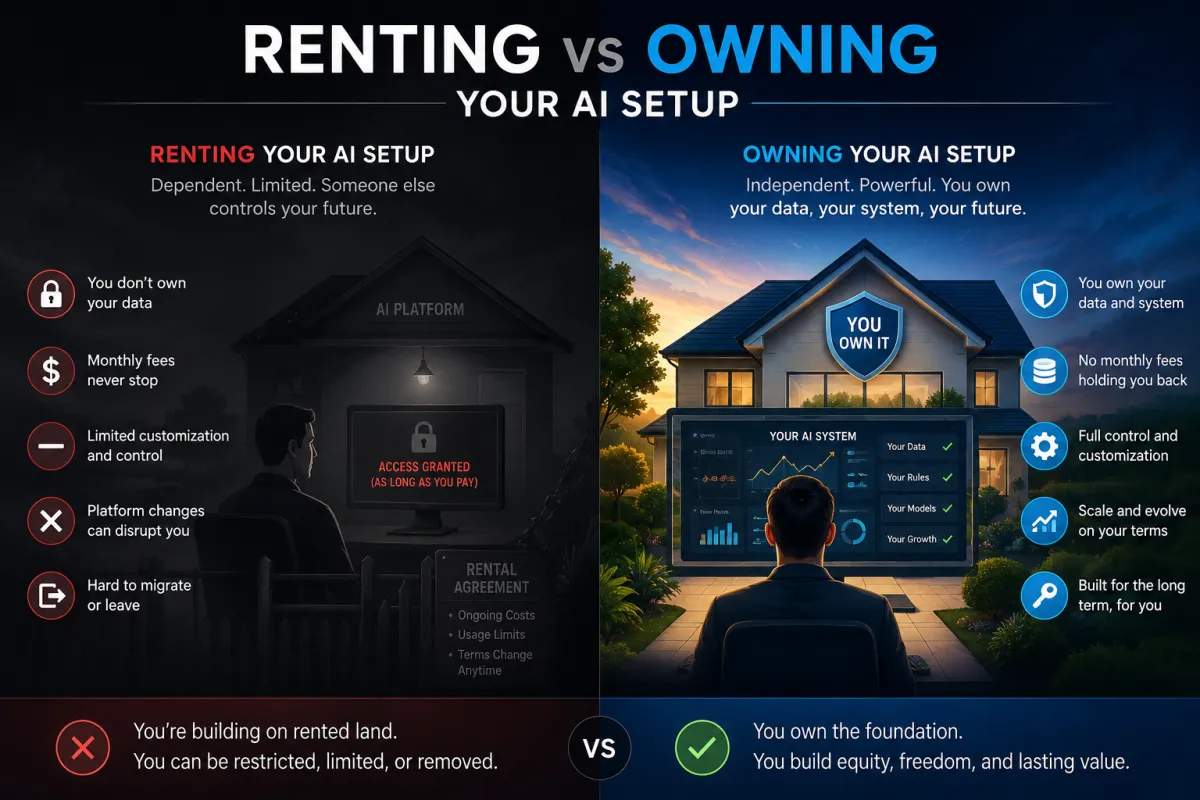
Renting AI vs. Owning Your AI Setup: What's the Difference?
Both are legitimate. Only one of them leaves you holding the parts when your vendor changes its mind.
The short answer: Renting AI means you pay for access to someone else's model, running under someone else's rules, on accounts someone else controls. Owning your AI setup means the data, the instructions, and the accounts are yours, and the vendor is a replaceable part. Almost no small business owns the model. Most can own everything else.
Bennin Systems builds these setups for small businesses from Paradise Valley, Montana, so this is a comparison written from the inside of both.
Here is the part that surprises people. The choice is not between using AI and avoiding it. In its Business Trends and Outlook Survey covering December 14, 2025 through May 3, 2026, published May 26, 2026, the Census Bureau found overall business AI use hovering between 17% and 20%, with 37% of firms with at least 250 employees reporting AI use and under 20% of firms with four or fewer employees. The small end of that gap is not a technology problem. It is usually a setup problem, because the fast way in is to rent everything, and renting everything is how a business ends up with a capability it cannot keep.
What does it actually mean to rent AI?
Renting AI means a subscription and a login are the whole of your position. The model belongs to the vendor. The chat history lives on the vendor's servers. The instructions that make the tool useful sit inside a text box in the vendor's interface. Cancel the plan, and the capability leaves with it. Enterprise contracts can add export rights, retention controls, and admin logs, which is worth paying for, though almost no business under twenty people is on one.
Renting is not a mistake. It is how most sensible people start, and how you find out whether a tool is worth anything before building around it. A rented tool costs less up front, requires no setup, and can be dropped with nothing lost but the monthly fee.
The trouble starts when the rental quietly becomes infrastructure. A tool you tried in March becomes the thing that answers your customers in August, and nobody stops to ask what the arrangement actually is.
What does it mean to own your AI setup?
Owning your AI setup means you hold the four parts that are actually holdable: your data, your written instructions, your accounts, and the workflow that connects them. The model itself is rented in almost every case, and that is fine, which is the same conclusion reached in the longer answer on setting up AI inside a business you actually own. Ownership is about whether swapping the model is a Tuesday afternoon of work or a rebuild from nothing.
That distinction matters because the model is the one part that is genuinely hard to own and the one part that matters least to your business. What makes an AI setup valuable is rarely raw model quality. It is the accumulated specifics: your customer list, your service area, your pricing logic, the way you answer the same six questions, the tone you use with people. That is also what owning your data actually means for a small business, stated in everyday terms rather than legal ones.
Open-weight models are the exception worth knowing about. OpenAI's gpt-oss-20b is published under a permissive Apache 2.0 license and can be downloaded and run on your own hardware. For most small businesses that is more machine than the job needs. But it means model ownership is a real option now, not a theory, which was not true two years ago.
What's the difference between renting AI and owning your setup, side by side?
The honest comparison is not "cheap and risky" against "expensive and safe." It is a difference in who holds the controls, and what a bad day looks like when it comes.
What are the three switches someone else can flip?
Three things can change without your consent when you rent: the model, the price, and the rules. None of them are hypothetical, and all three are documented in public by the vendors themselves. Knowing which of the three would actually hurt you is the whole decision.
The model switch. Microsoft's published lifecycle policy for models in its Foundry catalog, updated July 24, 2026, sets a retirement date 18 months out at the moment a generally available model launches. At 18 months, in Microsoft's own words, all inference returns 410 Gone. The policy states that retirement dates are not extendable, and that generally available models in that catalog from Anthropic, DeepSeek, Fireworks, and Mistral AI run a 12-month lifecycle instead of 18. Customers get at least 60 days notice. That is a responsible policy, published clearly, and it still means the engine under your tool has an expiration date you did not set.
The price switch. Rented AI is priced per seat or per use, and both go up. The European Union wrote a rule about the exit cost specifically. The Data Act has applied since 12 September 2025, and in the European Commission's own wording it "will also entirely remove switching charges, including charges for data egress (i.e. charges for data transit), from 12 January 2027". The United States has no single nationwide law comparable to that switching-charge rule, so American small businesses get whatever their contract says and nothing more.
The rules switch. Read which door you came in through, because the same vendor often runs two sets of rules. Anthropic's commercial terms, effective June 17, 2025, state that "Anthropic may not train models on Customer Content from Services" and that the customer "owns its Outputs." The consumer help article, effective March 16, 2026, describes a different arrangement for Free, Pro, and Max accounts, where chats are used to improve the model when "You choose to allow us to use your chats and coding sessions to improve Claude". Same company, same underlying model, different terms depending on which plan you signed up for. Most owners have never checked which one they are on.
When is renting the right call?
Rent when the thing you are testing might not survive the quarter. Rent when the tool is a convenience rather than a dependency. Rent when the cost of it disappearing is an afternoon of annoyance instead of a week of scrambling and an apology to customers. That covers a lot of ground, and pretending otherwise would be dishonest.
The line to hold is this one. Anything a customer touches, and anything you would have to rebuild from memory, usually belongs on the owned side. A drafting assistant for your own writing can stay rented forever. The thing that answers your phone at 6 p.m. cannot.
Scotty's Oil, a family fuel and petroleum business, runs a chatbot named Emma that takes orders and routes them to the team, which is a fair picture of what an AI assistant can actually do for a small business right now. Nancy Clark's real estate operation runs on a system that captures inquiries and follows up without anyone remembering to. In both cases the useful part is not the model. It is the accumulated business logic underneath, which is exactly the part that would have been trapped in a vendor's interface if it had been built as a rental.
What does moving toward ownership actually look like?
It looks smaller than people expect, and it starts with an export rather than a purchase. Ownership is a property of where things live, not a product you buy, which is why the first move costs nothing.
Do this one this week. Export your customer list and copy out every instruction you have written into an AI tool, the prompts, the canned answers, the tone notes, the service details you keep retyping. Put both in a dated folder on a computer you control. That folder is the difference between switching vendors and starting over.
The mechanism is worth saying out loud, because it is the reason this works. When your business record lives as plain files in a store you control, any AI tool can be pointed at the same files. The instructions are portable because they are just text. If a vendor shuts down, raises prices, or changes its terms, you point the next tool at the same folder and lose a day instead of a year. Rented setups fail the other way, where the value lives inside the interface and cannot leave it.
The category to look for is a neutral data store: something that holds your records in a common format, exports on demand without a support ticket, and is not owned by the same company that provides the AI. Plenty of these exist, and where your business data lives matters more than it used to precisely because AI tools now read it. Knowing what exists is the point of this post. Wiring it into how you actually work is a different job.
The bottom line
Renting AI is a reasonable way to start and a poor way to run anything customers depend on. Owning your setup does not mean owning a model, and for most small businesses it never will. It means holding the data, the instructions, and the accounts, so that the model becomes a part you can replace instead of a landlord you have to please. That is a decision about who controls your operation, not a decision about technology.
Next steps
Pick the single AI tool your business would miss most if it vanished tomorrow. Find out three things about it: whose name the account is in, whether you can export what it holds without asking anyone, and which plan tier's terms you actually agreed to. If the answers make you uncomfortable, that tool is infrastructure you are renting.
If you want help moving the parts that matter onto ground you own, without ripping out what already works, Bennin Systems builds systems businesses keep. The plan is the same every time: map the process, build the system, teach you to run it.
Frequently asked questions
Can a small business really own its AI setup, or is that just for big companies?
Yes, and the cost is mostly attention rather than money. Owning your setup means your data, your written instructions, and your accounts are yours. That is a matter of where things live and whose name is on the bill, not a matter of company size or budget.
Do I have to run my own AI model to own my setup?
No. Almost no small business owns the model, and for most that is the right call. Open-weight models like gpt-oss-20b are available under permissive licenses and can run on your own hardware, but the value in your setup is your data and instructions, not the engine.
What happens if the AI model my business uses gets retired?
Retirement is normal and scheduled. Microsoft's Foundry lifecycle policy sets a retirement date 18 months from launch for generally available models, with at least 60 days notice, after which requests return a 410 Gone error. If your instructions and data are portable, that is a swap. If they are not, it is a rebuild.
Is my business data being used to train AI models?
It depends entirely on which plan you signed up for. Anthropic's commercial terms state that Anthropic may not train models on Customer Content from Services, while the consumer plans describe using chats to improve the model when the user allows it. Check your tier's terms, not the company's reputation.
What is the difference between owning my data and owning my AI setup?
Owning your data is one of four parts. The full setup also includes your written instructions, the accounts everything runs under, and the workflow connecting them. A business can hold its customer list and still lose its capability if the instructions and accounts belong to someone else.
Are there legal protections if I want to switch AI or cloud providers?
In the European Union, yes. The Data Act has applied since 12 September 2025 and removes switching charges, including data egress charges, from 12 January 2027. The United States has no single nationwide equivalent, so American businesses rely on their contracts and on how portable they made things in the first place.
Is renting AI ever the better choice?
Often. Rent anything experimental, short-term, or easy to abandon, because renting costs less and commits you to nothing. Own anything customers touch and anything you would have to rebuild from memory. The test is what a bad day costs you, not what the subscription costs.
Bennin Systems, Paradise Valley, Montana. (406) 224-3267. benninsystems.com
Stacy Bennin is the founder of Bennin Systems, where she builds the automated systems small businesses need but rarely have time to set up themselves: lead capture and follow-up that runs on its own, chatbots that answer questions and take orders around the clock, custom websites that act as an employee, and the back-office workflows that keep an operation from running on memory and sticky notes. Located in Montana, she works with businesses and real estate professionals anywhere in the United States. She is also a licensed Montana real estate broker affiliated with Legacy Lands Real Estate. Reach her at benninsystems.com.
